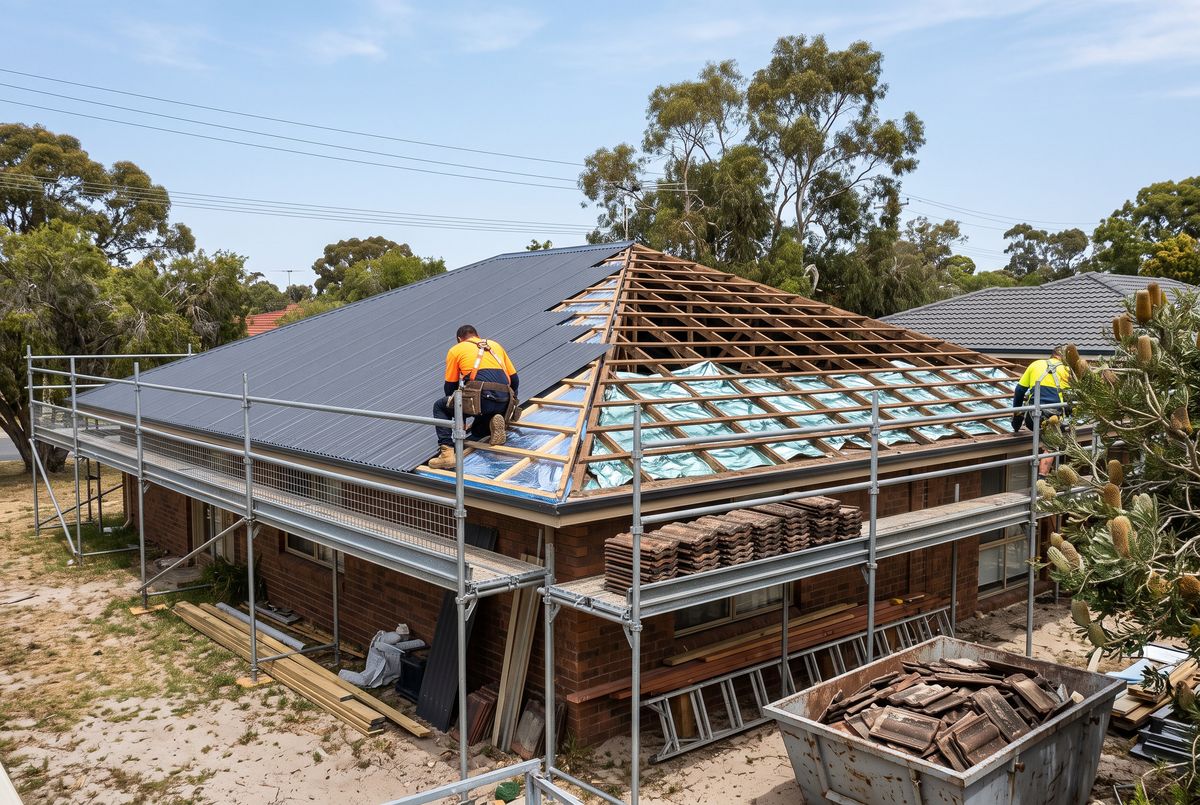
Beneath a roof covering there may be several layers, or almost none. Sarking and insulation are the two most often discussed when a roof is replaced, and they are easy to confuse: sarking sits directly under the tiles or sheets, while insulation usually sits on top of the ceiling. They do different jobs and are installed at different times.
The diagram shows where sarking sits in a typical tile roof, between the rafters and the battens that carry the tiles.
What does roof sarking do?#
Sarking is a second line of defence: it deals with whatever gets past the tiles or sheets. It has three main jobs.
- Water. Tiles are not completely watertight in heavy, wind-driven rain. Sarking catches water that blows under the laps or comes through a cracked tile and guides it down to the gutter rather than onto the ceiling.
- Dust. It cuts down the dust, leaf litter and grit that blow into the roof space through gaps between tiles, which is noticeable in dry, windy summers.
- Heat. Reflective sarking, usually a foil laminate, reflects radiant heat from the hot roof covering back upwards, so less of it reaches the roof space. Like other reflective products, it needs an air gap beside it to work and loses some effect as dust settles on it.
Under metal roofs, sarking or an insulation blanket also helps manage condensation on the underside of the sheets. And in bushfire prone areas, sarking is one of the elements covered by AS 3959, the bushfire construction standard, so ask whether its requirements apply to your roof.
Does my roof have sarking?#
Many older Perth tile roofs have none. From inside the roof space, a roof without sarking shows the underside of the tiles and battens directly. With sarking, you see a foil or woven membrane draped over the rafters below the battens. Building inspection reports often comment on it, as our guide to roof issues in building inspection reports explains.
The easiest way to find out is to ask whoever next works in your roof space, such as an electrician, insulation installer or roof inspector, to check and take a photo. In WA, workers must have the mains power switched off before entering the roof space of a house. If you are thinking of looking yourself, read roof safety for homeowners first.
Can sarking be added to an existing roof?#
Normally only when the roof covering comes off. Standard sarking runs over the rafters or trusses and under the battens, so on a tile roof the tiles and battens have to be lifted, the sarking laid and the battens and tiles refixed or replaced. In effect that is a reroof, even if the original tiles go back on. On a metal roof, the sheets come off.
That is why sarking is usually added during a roof replacement or a tile to metal conversion. If part of the roof is being opened up for a major repair, ask whether sarking can be added there and how it would drain into the gutter.
Some products are sold for fitting from inside the roof space, between the rafters. They may add some insulation, but ask how they deal with water that gets past the tiles, because carrying that water to the gutter is sarking’s main job.
How is sarking different from ceiling insulation?#
They sit in different places and solve different problems.
| Layer | Where it sits | Main job | When it is usually installed |
|---|---|---|---|
| Sarking (plain or reflective) | Directly under the tiles or sheets, over the rafters | Drains water that gets past the covering, limits dust and, if reflective, cuts radiant heat | New roof or reroof |
| Insulation blanket under metal | Under the sheets, over the battens | Insulation, condensation control and less rain noise | New roof or reroof |
| Ceiling insulation (batts, rolls or loose-fill) | On top of the ceiling, in the roof space | Slows heat moving between the roof space and the rooms | Any time, from inside the roof space |
| Roof-space ventilation | Vents in the roof, eaves or gables | Lets hot or moist air out of the roof space | Any time, though roof vents involve roof work |
The Australian Government’s energy.gov.au guidance describes two broad types of insulation. Bulk insulation, such as batts, rolls, loose fill or foam boards, traps air in still layers to resist the movement of heat. Reflective insulation, typically aluminium foil laminated onto paper or plastic, reflects heat in the direction the foil faces. Products carry an R-value, which measures resistance to heat flow: the higher the number, the more it resists. Poor installation can significantly reduce a product’s performance, and a licensed electrician should confirm wiring is safe to cover before insulation goes in.
What about condensation and ventilation?#
Condensation forms when warm, moist air meets a cold surface. Moisture from showers, cooking and breathing rises into the roof space, and on clear, cold nights it can condense on the underside of metal sheets or other cold surfaces. The drips can wet insulation and stain ceilings, and are sometimes mistaken for a leak.
Under metal roofs, sarking or a suitable membrane catches and drains that moisture, and ventilation lets moist air escape. Ask whether bathroom and kitchen exhaust fans discharge outside rather than into the roof space. Ventilation openings also have to be detailed so they do not admit wind-driven rain or dust. YourHome advises that all insulation be installed following the product specifications, to minimise the risk of condensation or fire.
Will sarking and insulation lower energy bills?#
They can reduce the heat that enters in summer and escapes in winter, but how much depends on the house, the insulation already there, the roof colour, shading, installation quality and how you heat and cool. Be cautious of quotes that promise a specific saving or temperature drop without explaining how it was worked out. Ask for product names, R-values and the installation method. Roof colour plays a part too, as the guide to roof colours and heat explains.
What safety issues apply in the roof space?#
WA rules make it mandatory for the mains power to be off before any worker enters the roof space of a house. The WA Government lists hazards including exposed live wiring, deteriorated cables in older homes and metallised foil insulation that may have become energised through poor installation, and advises keeping thermal insulation away from light fittings. If the roof is asbestos cement, WA Health notes that removing it can require the roof space to be cleaned up, which may mean replacing existing insulation; see asbestos roof replacement.
Questions to ask when sarking or insulation is quoted#
- Which product is it: plain sarking, reflective foil laminate, a vapour-permeable membrane or an insulation blanket?
- How will it be lapped, supported and drained into the gutter?
- What is the R-value of any insulation, and will existing ceiling insulation be disturbed or reinstated?
- How will condensation and roof-space ventilation be handled?
- Do bushfire (BAL) or energy-efficiency requirements affect the choice?
- Is the work included in the reroofing price or listed as a separate item?
Terms you meet in these quotes, such as batten, rafter, truss, lap and roof space, are explained in the roof glossary.
Frequently asked questions
Is sarking required under a new roof?
It depends on the roof covering, pitch, location and design, and in bushfire prone areas on the site’s Bushfire Attack Level. A building surveyor or the contractor can explain what applies. Even where it is optional, a reroof is the practical time to consider it.
Can sarking be installed without removing the tiles?
Not in the usual way. Standard sarking runs over the rafters and under the battens, so the tiles and battens have to come off. Products fitted from inside the roof space are different, so ask what they do about water that gets past the tiles.
Will sarking stop roof leaks?
It can catch small amounts of water that get past the tiles or sheets and carry it to the gutter, but it is a backup rather than a repair. Old sarking can be torn, sagging or perished, and any leak still needs fixing at its source.
What happens if the sarking under my tiles is torn or sagging?
A small tear may let water past in that spot, while sarking that sags and holds water, or has perished, can send water onto the ceiling instead of into the gutter. A contractor can assess it from the roof space, and a proper repair usually means lifting tiles in that area.
Should ceiling insulation be replaced when the roof is replaced?
Not automatically. A reroof does not usually disturb the insulation lying on the ceiling, but it is a good moment to check its condition and coverage. If the old roof was asbestos cement, the roof space may need cleaning up first, which can mean replacing the insulation.