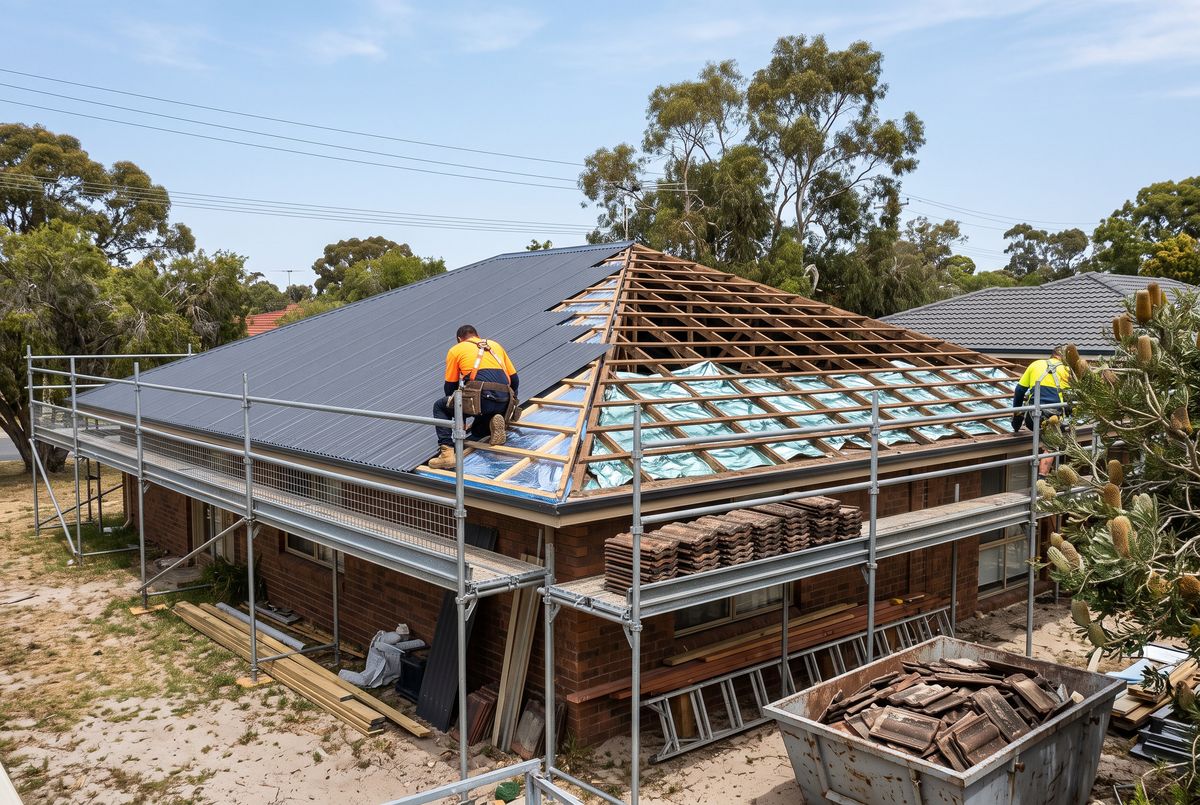
Replacing a roof is a larger and more regulated job than repairing or restoring one. The old covering comes off, the structure underneath is exposed, and decisions about battens, sarking, insulation, gutters and tie-downs all have to be made while the roof is open. Some of those decisions also bring building permits and contract rules into play.
Most Perth reroofs fall into two groups: like-for-like replacements, such as tile to tile or steel to steel, and conversions from tile to steel. Asbestos cement roofs are a third, separate case.
When is roof replacement justified?#
Replacement makes sense when the roof covering or the parts holding it up are no longer worth repairing. An inspection should establish which of these apply:
- Tiles cracking across many slopes, or so brittle they break when handled.
- Steel sheets rusted through in many places, or corrosion along most of the laps.
- Sagging roof lines or failing battens.
- Repeated leaks from different points despite earlier repairs.
- An asbestos cement roof that is deteriorating or due to be removed.
- Widespread storm damage.
- A renovation or extension that changes the roof.
If only part of the roof is affected, or the problems are mainly at the surface, a repair or roof restoration may be enough. The repair, restoration or replacement guide sets out how to compare them.
Partial or full replacement?#
Replacing one section, such as a rear wing, a verandah or the slopes facing the weather, can make sense when the rest of the roof is sound. The weak points are the junctions where new meets old: flashings, ridges and laps need careful detailing, and new tiles or sheets will look different from weathered ones. On metal roofs, the new and old materials must also be compatible, because water draining from some metals onto others speeds up corrosion. Ask the contractor how the junctions will be finished and whether the remaining roof is likely to need work soon.
Converting a tile roof to metal#
Tile to steel is a common Perth reroof. The tiles and often the battens are removed, new battens suited to the sheeting are fixed, sarking or an insulation blanket is laid, and pre-painted steel such as COLORBOND steel is fixed with new ridge capping, flashings and often new gutters.
Steel sheeting is lighter than tiles, which changes how the roof resists wind. Industry Bulletin 53 notes that lighter cladding may need additional tie-downs to resist wind uplift. The guide to converting a tile roof to metal covers the process, and tile vs metal roofs compares the materials.
Do you need a building permit to replace a roof?#
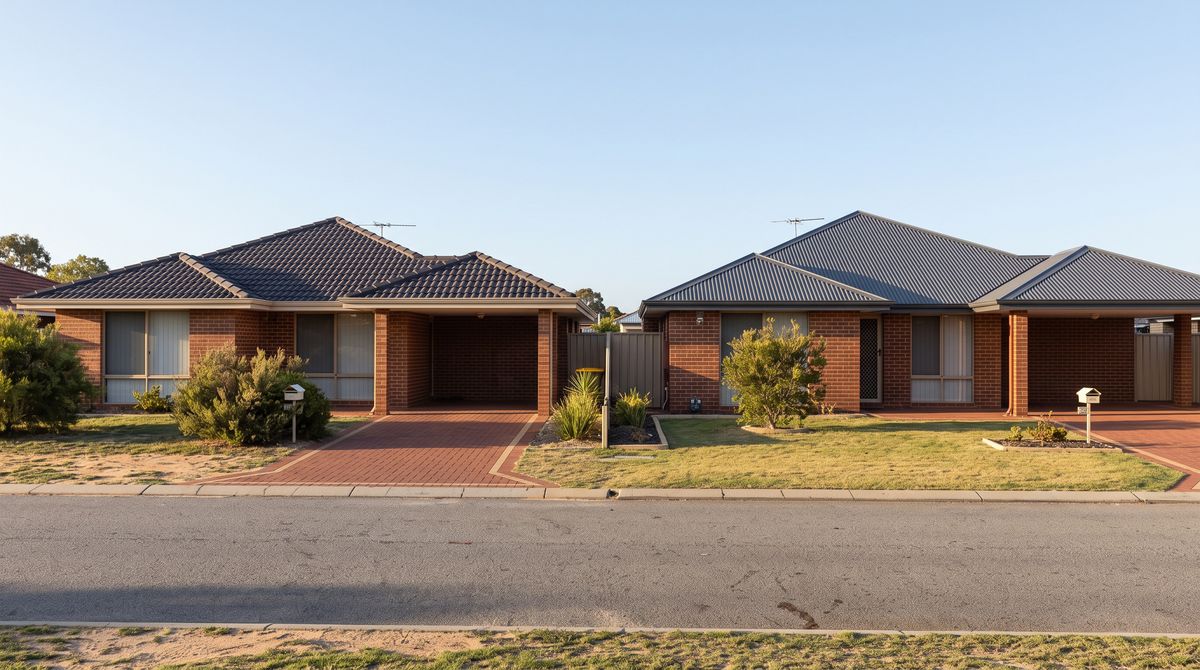
It depends on what changes. Under the Building Regulations 2012, repair and renovation work that does not adversely affect the structure can be exempt from a building permit. Industry Bulletin 53 explains how this applies to roofs:
- Same material and profile: unlikely to affect the structure, so often exempt.
- Different material or profile: could affect the structure, for example by needing more tie-downs, so a permit may be required.
- The permit authority decides case by case.
Building and Energy’s guidance is that replacing a roof covering with a different shape or weight will usually require a building permit, so a change from tiles to steel sheeting normally needs one. A like-for-like replacement may fall under the repair exemption if no structural work is involved. Check with your local government before you sign. See building permits for roof work in WA.
Who is allowed to do the work?#
In WA, “builder work” is building work that needs a building permit, is valued at $20,000 or more and is in the prescribed area of the state, which includes Perth. Builder work must be done by a registered building contractor. You can check registration online through the WA Government’s building services register or the ServiceWA app.
A real example. In a case announced by the WA Government in 2025, an unregistered roofer replaced a tile roof in Floreat with corrugated steel. The job needed a building permit and was valued above $20,000, so it required a registered building contractor. The roofer was fined, and had also taken a deposit far above the legal limit.
Contracts and deposits#
The Home Building Contracts Act 1991 applies to home building work contracts valued between $7,500 and $500,000. For those contracts:
- The contract must be in writing, contain all the terms, be dated and be signed by both parties. An oral agreement does not comply.
- A deposit taken before work starts cannot exceed 6.5 per cent of the contract price.
- You must be given the prescribed notice of your rights and obligations before signing.
Consumer Protection WA also advises getting written quotes, avoiding open-ended contracts and not paying the whole job upfront. If a salesperson comes to your home uninvited, you generally have 10 business days to reconsider. See roofing contracts and your rights in WA.
Tie-downs and wind uplift#
Tie-downs are the straps, brackets and fixings that connect the roof frame to the walls so wind cannot lift the roof. A WA Government investigation into wind-damaged homes found unpermitted reroofing and inadequate tie-downs among replacement roofs, especially where the roofing material had changed. Ask how tie-downs will be checked and upgraded, and whether an engineer or building surveyor will be involved.
What else is worth doing while the roof is off?#
| Item | Why consider it now | Ask about |
|---|---|---|
| Sarking and insulation | Easiest to install with the covering removed; many older tile roofs have no sarking | Which product, and how it suits the new covering. See sarking and insulation |
| Battens | Old battens may not suit new sheeting or may be decayed | Whether battens are replaced and with what |
| Gutters, downpipes and fascia | Often disturbed during the work, and colours can be matched | Whether they are in the quote. See gutter repairs |
| Flashings and valleys | New covering needs new flashings | Materials compatible with the new roof |
| Solar panels | Must come off and go back on | Who disconnects and reinstalls them |
| Bushfire requirements | New work in a mapped bushfire prone area may need to meet the site’s BAL | Whether the local government requires a BAL assessment |
In WA, solar installers must be licensed electrical contractors and only licensed electricians may do the electrical work, so panel removal and reinstatement should be planned and priced up front. The guide to roof work and solar panels explains the sequence.
What about asbestos cement roofs?#
Removing more than 10 m² of non-friable asbestos, or any friable asbestos, must be done by a licensed asbestos removalist, and WorkSafe strongly recommends a licensed removalist for any removal. Asbestos waste must be wrapped, labelled and taken to a licensed facility, and asbestos roofs must never be pressure cleaned. See asbestos roof replacement.
What should a roof replacement quote clarify?#
- Scope: full or partial, and exactly which sections.
- Materials: covering, profile, colour, battens, sarking or insulation, fixings and flashings.
- Permit and registration: who applies for any permit, and the contractor’s registration number if the work is builder work.
- Tie-downs: how they will be assessed and upgraded.
- Exclusions: gutters, solar panels, ceilings, asbestos removal and electrical work.
- Payments: deposit, progress payments and what triggers each one.
What is usually included, and what is not?#
| Usually included | Often extra or excluded | Worth asking about |
|---|---|---|
| Removal and disposal of the old covering | Asbestos removal by a licensed removalist | Who arranges the removalist |
| New covering, ridge capping and flashings | Gutters, downpipes and fascia | Whether trims match |
| New battens where specified | Tie-down upgrades found to be needed | How tie-downs are assessed |
| Sarking or insulation if listed | Solar panel removal and reinstatement | Who the electrician is |
What affects the price of a roof replacement?#
- Roof area and pitch, which set the quantity of material. Our roof area calculator gives a starting estimate.
- Material choice and profile.
- Removal, especially if asbestos is involved.
- Structure: battens, tie-downs and any framing repairs.
- Extras: sarking, insulation, gutters, fascia and solar work.
- Access and height, including scaffolding for two-storey homes.
- Permits and any engineering.
See roof replacement costs in Perth for more.
Questions to ask the contractor#
- Does this job need a building permit, and who will apply for it?
- Are you a registered building contractor, and what is your registration number?
- How will you check and upgrade the tie-downs?
- Will the battens be replaced, and is sarking or insulation included?
- What deposit do you require, and when are progress payments due?
- How will solar panels, gutters and any asbestos be handled?
Frequently asked questions
Does a like-for-like tile reroof need a building permit?
Often not, if the same material and profile are used and no structural work is proposed, but the permit authority decides. Ask your local government before work starts.
How do I check whether a roofer is a registered building contractor?
Search the WA Government’s online register of building service providers, or use the ServiceWA app. Ask the contractor for their registration number and check that the name matches the contract.
Does a reroofing contract have to be in writing?
Yes, if it is a home building contract valued between $7,500 and $500,000. It must be written, dated, signed by both parties and contain all the terms, and any deposit before work starts cannot exceed 6.5 per cent of the contract price.
Can solar panels go back on after the roof is replaced?
Usually, yes. The panels are disconnected and removed before the old roof comes off and reinstalled afterwards. The electrical work must be done by a licensed electrician, so confirm who is responsible and include it in the quote.
Is it possible to replace only one section of a roof?
Yes. A partial reroof can suit a roof where one area has failed and the rest is sound. Ask how the junction between old and new will be sealed and how different the two sections will look.
Sources
- WA Government: Industry Bulletin 53, roof cladding replacements
- City of Vincent: building permits for your property
- WA Government: do I need to be a registered builder?
- WA Government: roofer fined over Floreat reroof
- WA Government: report raises the roof on replacement compliance
- Home Building Contracts Act 1991 overview
- Consumer Protection WA: solar panel systems factsheet
- WorkSafe WA: removing asbestos