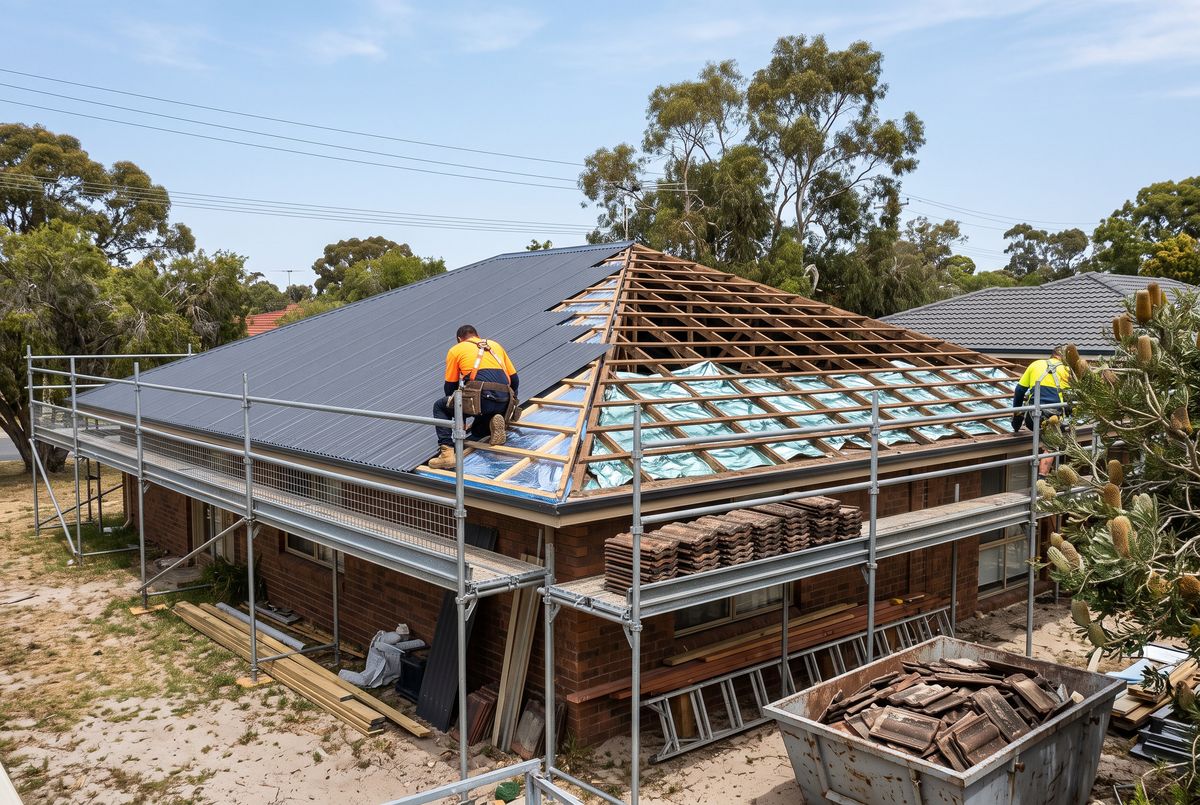
Replacing a roof is a large job, and the quote is made of many separate pieces of work. Some, such as the new covering, are obvious. Others, such as tie-down upgrades, permits and reinstating solar panels, are easy to miss until they appear as extras.
This page sets out the components a reroofing quote should account for and what changes each one. For deciding whether replacement is the right job, see roof replacement.
What goes into a roof replacement quote?#
A complete quote should address each of these, even if only to say “not required” or “by others”.
| Component | What it covers | What to ask |
|---|---|---|
| Removal and disposal | Stripping the old tiles or sheets and taking them away | Where the waste goes and whether skip bins are included |
| Asbestos removal | Licensed removal of asbestos cement sheeting | Whose licence, and who arranges clearance |
| New covering | Tiles or steel sheets, ridge caps and fixings | Brand, profile, colour and grade |
| Battens and framing | Replacing battens and repairing rafters or trusses | How damage found after stripping will be priced |
| Sarking and insulation | Membrane under the covering, and any new insulation | Which products, and whether old insulation stays |
| Tie-downs | Fixing the roof structure to the walls | Whether an engineer checks the design |
| Flashings | Walls, chimneys, skylights, vents and valleys | Whether all flashings are new |
| Gutters, fascia and downpipes | Replacing or reusing the roof drainage | Whether they are in or out of scope |
| Permit and certification | Building permit application and any engineering | Who applies, and who is the registered builder |
| Fixtures | Solar panels, air conditioning, aerials and vents | Which trades remove and reinstate them |
| Access and safety | Scaffold, edge protection and a lift for materials | Whether included and for how long |
| Weather protection | Covering the house between stages | What happens if rain arrives mid-job |
How do removal, disposal and asbestos affect the price?#
Removal is labour plus disposal, so the weight and volume of the old roof matter. Concrete tiles are heavy and bulky; old steel sheets are lighter. Ask whether the quote includes bins, transport and disposal fees, or whether you need to arrange them.
Asbestos cement roofs are different. More than 10 m² of non-friable asbestos must be removed by a licensed asbestos removalist, which a whole roof always exceeds. The removal, clearance inspection and disposal to a facility licensed to accept asbestos are usually a separate quote. Our asbestos roof replacement page explains how the two trades fit together.
How does the choice of new roof change the cost?#
The material is one of the biggest decisions, and it affects more than the covering itself. Points that change the quote include:
- Tile or steel. Moving from tiles to steel changes the battens, fixings and flashings, and usually triggers a building permit. See converting a tile roof to metal and our tile vs metal roof comparison.
- Profile and colour. Some profiles and colours can cost more or take longer to supply.
- Coastal grade. Near breaking surf, manufacturers recommend more corrosion-resistant steel products and compatible fixings. Ask which product and warranty suit your exact site.
- Bushfire prone areas. In mapped areas, a Bushfire Attack Level (BAL) assessment may set requirements for new roof work. Ask your local government whether it applies.
Why can battens, framing and sarking change the total?#
Much of the roof structure is hidden until the old covering comes off. Battens may be rotten or the wrong spacing for the new material, and rafters or trusses may have sagged. Building and Energy notes that roof supports can sag or deteriorate over time, even when the replacement uses the same material.
Good quotes handle this uncertainty openly, usually with a rate for replacement timber or an allowance that you approve before it is spent. Sarking and insulation are also easier to add while the roof is open; our guide to roof sarking and insulation explains the options.
Why do tie-downs and permits matter?#
Tie-downs hold the roof to the house against wind uplift. WA’s Industry Bulletin 53 explains that changing the cladding material or profile could affect the structure, for example lighter cladding may need additional tie-downs. The permit authority decides case by case. Building and Energy’s guidance is that replacing a roof covering with a different shape or weight will usually require a building permit, so the cost of a tile-to-steel change normally includes a permit and any tie-down upgrades.
Building and Energy’s review of storm-damaged roofs found that replacement roofs were over-represented, many installed without required permits and with inadequate tie-downs. It recommends having the existing roof structure and any design upgrades checked by a structural engineer or registered builder.
Building work that needs a permit, is valued at $20,000 or more and is in the prescribed area, which includes Perth, is “builder work” and must be done by a registered building contractor. In one prosecution announced in 2025, an unregistered roofer was fined over a Floreat tile-to-steel reroof that needed a permit. You can check registration on the WA Government register or the ServiceWA app. See building permits for roof work.
What else changes the total?#
Beyond materials and structure, the main factors are:
- Roof size, pitch and shape. Hips, valleys and multiple levels take longer than a simple gable.
- Two storeys. More scaffold and edge protection, and more handling of materials and waste.
- Access. Narrow side setbacks, where a bin or truck can park and whether a crane or lift is needed.
- Fixtures. Removing and reinstating solar panels, air-conditioning units and aerials needs the right licensed trades.
- Gutters and fascia. Replacing them at the same time is common, but it must be in the scope. See gutter repairs.
How do I compare roof replacement quotes?#
Check that every quote covers the same components from the table above, with the same materials named. Pay particular attention to tie-downs, the permit, the registered builder, batten allowances, gutters and fixtures, because these items are easy to leave out or describe vaguely. Consumer Protection WA suggests at least three written quotes.
For contracts valued between $7,500 and $500,000, the Home Building Contracts Act requires a written contract signed and dated by both parties, with the prescribed notice of your rights, and the deposit taken before work starts cannot exceed 6.5 per cent of the contract price.
Questions to ask about the price#
- Does the quote include removal, bins and disposal?
- Is asbestos involved, and who holds the removal licence?
- How will rotten battens or framing be priced and approved?
- Are tie-downs being checked or upgraded, and by whom?
- Does this job need a building permit, and who is the registered builder?
- Are gutters, fascia, downpipes and flashings new or reused?
- Who removes and reinstates solar panels and air conditioning?
- How will the house be protected from rain during the work?
Frequently asked questions
Do I need a structural engineer for a roof replacement?
Not on every job, but Building and Energy recommends having the existing roof structure and any design upgrades checked by a structural engineer or registered builder, especially when the new covering is a different shape or weight. Ask whether the quote includes this check.
Why might a lighter metal roof need extra tie-downs?
A heavy tile roof is partly held down by its own weight. When lighter steel sheeting replaces it, the roof structure may need additional tie-downs to resist wind uplift, which is why the design should be checked.
What happens if rotten battens are found once the tiles are off?
A well-written quote says how this will be handled, usually with a rate per batten or an allowance. A tradesperson must get your permission before doing extra work, so ask to be shown the damage and approve the cost first.
Can the new roof be a different profile or colour from the old one?
Generally yes, but changing the material or profile can affect the structure and whether a building permit is needed, as WA’s Industry Bulletin 53 explains. Heritage-listed homes may also need approval, so check with your local government before choosing.
Do I need to move out during a roof replacement?
Many households stay, but it depends on the roof, the weather and whether asbestos is being removed. Ask the contractor what to expect each day, including noise, dust, access and how the house will be kept weathertight.