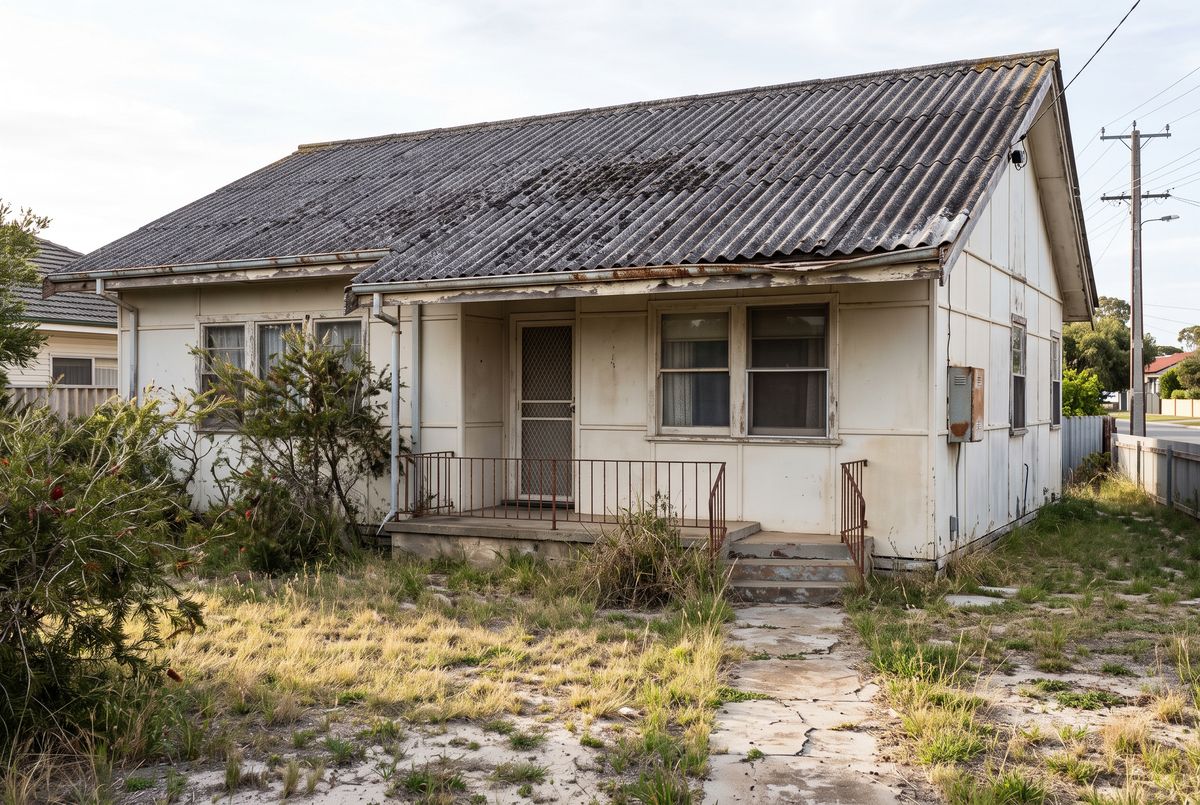
Many older Perth homes still have corrugated asbestos cement roofs, often grey, weathered and spotted with lichen. WA Health’s position is to encourage early and safe removal of these roofs, and it notes that it is safer, and usually much less expensive, to remove and replace a roof while it is still relatively intact rather than after it has broken up.
This page explains how the removal and the new roof fit together and what each quote should spell out. For background, read our guide to asbestos roofs in Perth.
Do not pressure clean, walk on, drill, cut, sand or break a suspected asbestos roof. High-pressure water cleaning of asbestos cement roofs is prohibited in WA because it spreads contaminated residue, including onto neighbouring properties. Aged sheeting is brittle, so walking on it is also a serious fall risk. Observe the roof only from the ground or from inside the house.
Is my roof likely to be asbestos cement?#
A roof is likely to be asbestos cement if it is made of cement-like sheeting and was installed before 1990. WA Health’s guidance lists the features that, especially in combination, point to asbestos:
- Grey cement sheeting (unless painted or discoloured), corrugated, about 7 mm thick.
- The “Super Six” brand, or a similar wide, deep corrugated profile.
- Usually seven corrugation ridges across each metre-wide sheet.
- Diamond-shaped metal fasteners holding the sheets down.
- Ridge capping in the same material, and sometimes asbestos cement gutters and downpipes.
These clues are strong but not proof. Only analysis of a sample by a NATA-accredited laboratory confirms asbestos, and WA Health advises treating the roof as asbestos until then. Ask an asbestos professional to take any sample.
When is replacement the right job?#
For an asbestos cement roof, replacement is usually the recommended path rather than ongoing repair. Anything beyond minor repairs breaches the Health (Asbestos) Regulations 1992, and replacing a damaged sheet with another asbestos sheet is illegal because re-use of asbestos is prohibited. Homeowners typically start the conversation when they notice:
- Cracked or broken sheets, or leaks and water stains on the ceiling below.
- A rough, weathered or flaking surface, or fibrous “whiskers” along the lower edges of the sheets.
- Overflowing or broken gutters, so runoff falls onto paths or garden beds.
- Branches rubbing on the roof, or storm damage.
- Plans to renovate, extend, add solar panels or sell.
Laying a new roof over the old sheets is sometimes suggested. WA Health advises against it, for reasons covered in the questions below.
How does removal and replacement work?#
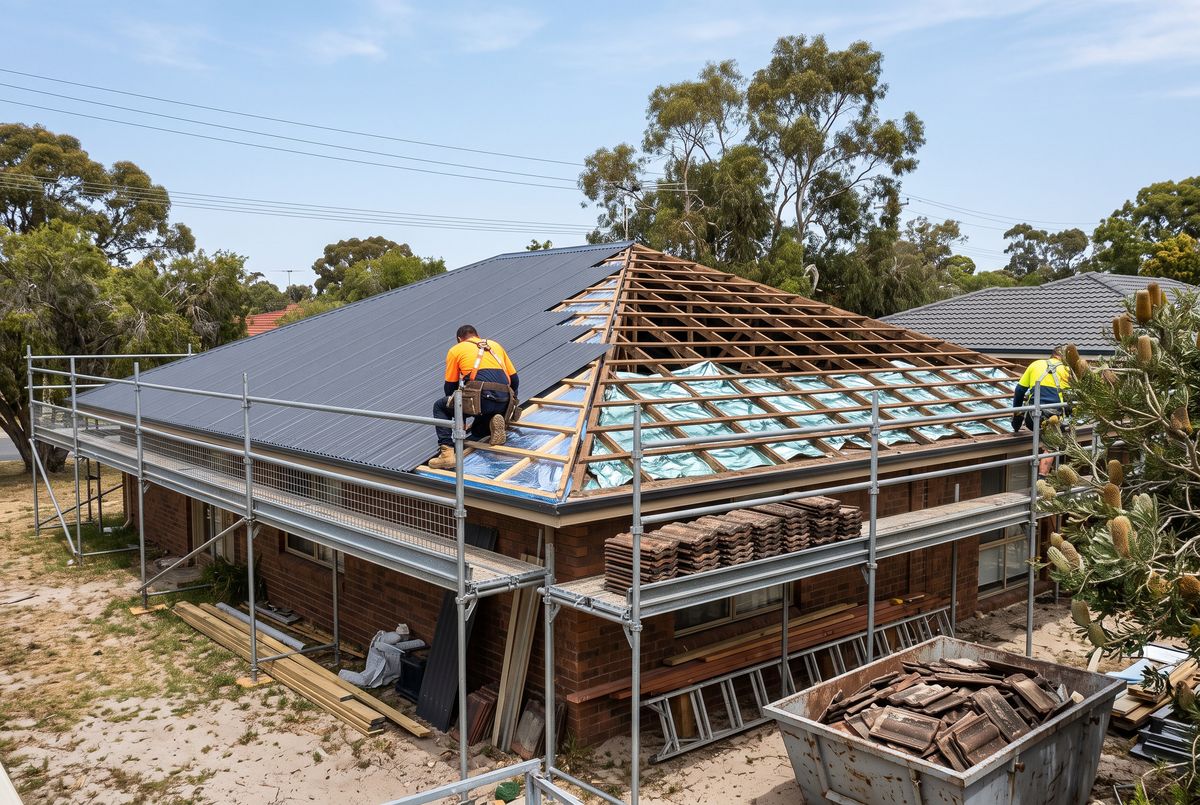
The licensed removal and the new roof are separate pieces of work, often by two businesses. Some roofing contractors coordinate both and subcontract a licensed removalist, so ask whose licence covers the asbestos work.
- Confirm the material. If the roof has not been tested, a sample is analysed or the roof is treated as asbestos.
- Get quotes for both trades. The two quotes should fit together without gaps, especially around gutters, the roof space and weather cover.
- Check permits for the new roof. This usually depends on the new material and any structural work. See building permits for roof work.
- Notification. The licensed removalist must notify WorkSafe at least five days before starting, and inform the people listed in the questions below.
- Removal. WA Health’s guidance describes wetting or sealing the sheets before removal, avoiding power tools that damage the sheets, wrapping sheets in heavy plastic labelled as asbestos, and lowering them to the ground rather than sliding them down chutes.
- Clearance. A clearance inspection is required after licensed Class A and Class B removal, and a written clearance certificate is issued before the area is reoccupied.
- New roof. Battens, sarking, tie-downs, the new covering, flashings and gutters are installed to the agreed scope.
Who usually does what?#
| Usually with the licensed removalist | Usually with the roofer or builder | Worth asking about |
|---|---|---|
| Removing sheets, ridge capping and fixings | New battens and any framing repairs | Who covers the roof if rain arrives between stages |
| Wrapping, labelling and transporting waste | Sarking, insulation and tie-downs | Whether insulation in the roof space is replaced |
| Asbestos gutters and downpipes, if present | New covering, flashings and ridge caps | Which party replaces the gutters and fascia |
| Cleaning asbestos debris from the roof space | Building permit, where required | Who arranges the clearance inspection |
| Notifying WorkSafe and informing neighbours | Reinstating solar panels and air conditioning | How the two schedules are coordinated |
Gutters matter because rain carries fibres off the roof into them, so contaminated or asbestos gutters and downpipes are usually removed with the roof. New gutters, downpipes and fascia then belong in the new-roof scope.
What should an asbestos roof quote state?#
The removal quote should let you check the licence, method and paperwork; the new-roof quote should describe exactly what replaces it.
- Licence details. The removalist’s business name, licence number and class. A whole roof is well over the 10 m² that a homeowner may remove, so a licensed removalist is required. Class B covers non-friable asbestos only; Class A covers friable and non-friable. Check the number on WorkSafe’s online licence search.
- Removal method. How sheets will be wetted or sealed, removed, wrapped and lowered, and how the work area will be kept clear of people.
- Roof space. Whether dust and debris in the ceiling space will be cleaned up, and whether existing insulation will be removed and replaced.
- Clearance. Who will carry out the clearance inspection and issue the certificate.
- Disposal. Where the waste will go and what disposal records you will receive. Asbestos cannot go in household bins; it must go to a facility licensed to accept it.
- New roof scope. The roofing material and profile, battens, sarking, insulation, tie-downs, flashings, gutters and downpipes, and the permit.
What affects the price of asbestos roof replacement?#
The total combines removal, disposal and the new roof. The main factors are:
- Roof area, pitch and levels. More sheeting means more removal, wrapping and disposal.
- Condition. Brittle or broken sheets take more care to remove intact.
- Associated materials. Asbestos ridge capping, gutters, downpipes or eaves add to the removal scope.
- Roof space. Clean-up of dust and replacement of insulation can be a significant item.
- Access. Narrow side setbacks, two storeys, nearby boundaries and where a waste vehicle can park.
- The new roof. Material choice, new battens, sarking, tie-down upgrades and any framing repairs.
- Fixtures. Solar panels, air conditioners and aerials to remove and reinstate.
For a breakdown of new-roof cost items, see roof replacement costs in Perth.
Do I need a permit for the new roof?#
Often, yes. WA’s Industry Bulletin 53 explains that changing the cladding material or profile could affect the structure, for example a lighter roof may need additional tie-downs against wind uplift. The permit authority decides case by case, and building work in Perth that needs a permit and is valued at $20,000 or more must be done by a registered building contractor.
Tie-downs matter. A Building and Energy report found that about half of the Perth buildings that lost roofs in storms had lightweight metal sheeting that had replaced heavy tile or asbestos cladding, and many replacement roofs had inadequate tie-downs. Ask how the new roof will be fixed to the frame and whether an engineer will check the existing structure. Our roof replacement page covers choosing the new covering.
Questions to ask the contractor#
- What is your asbestos licence number and class, and is it current?
- Will you, or a subcontractor, remove the asbestos? Whose licence covers it?
- How will the roof space be cleaned, and will insulation be replaced?
- Who carries out the clearance inspection, and will I get a copy of the certificate?
- Does the new roof need a building permit, and who applies for it?
- How will the house be kept weathertight between removal and the new roof?
Frequently asked questions
Can I remove an asbestos roof myself?
No. A homeowner may remove up to 10 m² of non-friable asbestos at their own home by following strict safety steps, but a whole roof is far larger than that. Removal of more than 10 m² of non-friable asbestos must be done by a licensed asbestos removalist.
Can an asbestos roof be painted or sealed instead of replaced?
WA Health says an asbestos structure can only be safely maintained where it has been kept well maintained and sealed or painted, and it strongly prefers complete removal over maintenance of ageing asbestos. Any cleaning before sealing must never use high-pressure water, which is prohibited.
Can a new roof be laid over the old asbestos sheets?
WA Health advises against covering an asbestos roof with a new roof. It postpones removal indefinitely, can expose future trades who do not know the asbestos is there, and does not address dust in the roof space.
Who confirms the site is safe after the old roof comes off?
After licensed removal, a clearance inspection is carried out and a written clearance certificate is issued before the area is reoccupied. Ask your removalist who will do the inspection and request a copy of the certificate for your records.
Do my neighbours need to be told about the removal?
At residential premises, the licensed removalist must inform the occupier, the owner and anyone occupying premises in the immediate vicinity before the work starts. The method is not specified, so ask the removalist how and when they will do it.
Sources
- WA Health: Guidance Note on Asbestos Cement Roofs
- WA Health: about asbestos
- WA Health: pressure cleaning asbestos cement roofs
- WorkSafe WA: removing asbestos
- WorkSafe WA: asbestos removal notifications
- WorkSafe WA: asbestos workers and removalists
- Building and Energy: report on replacement roof compliance
- Industry Bulletin 53: roof cladding replacements