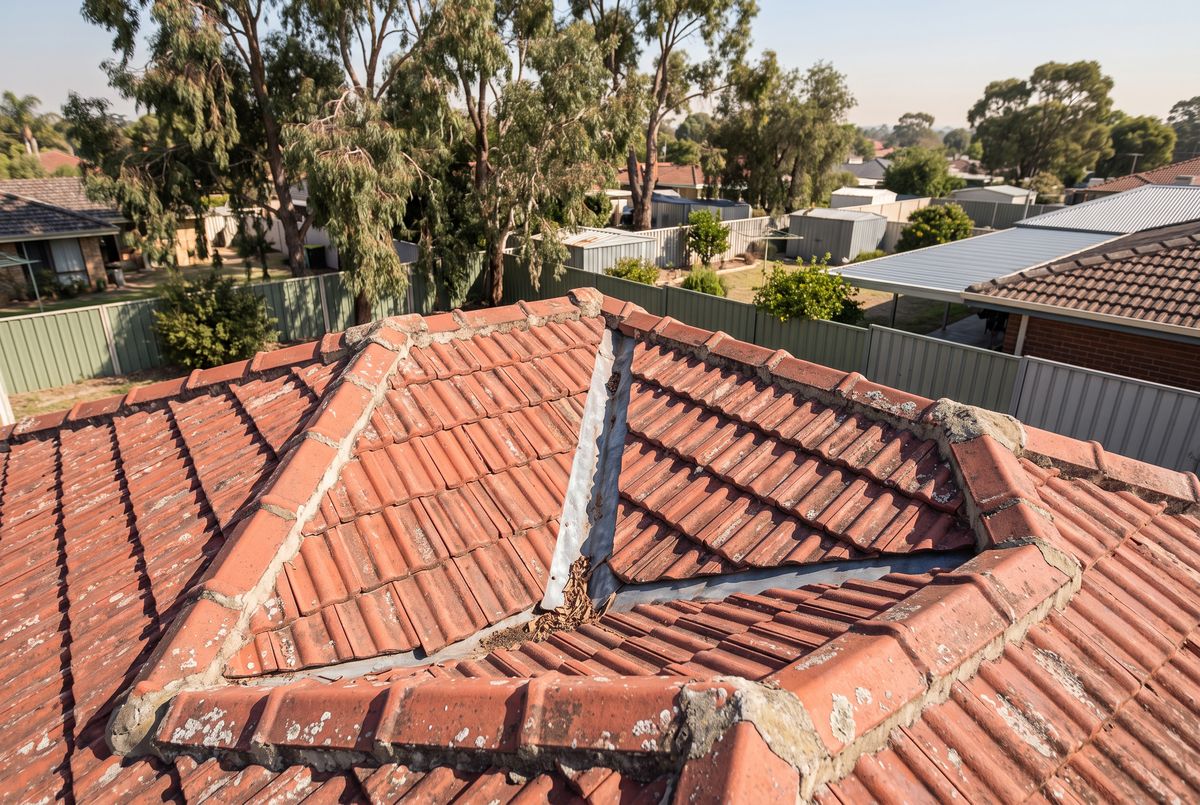
Roofing quotes and building reports use a lot of trade words, and the same part can have two or three names. Knowing what each term means makes it much easier to check what a quote includes and what a report is actually saying.
The diagram below shows where the main parts of a pitched roof sit. Terms are then listed alphabetically, with links to the guides that explain them in more depth.
A#
Allowance
A set quantity or amount included in a quote for work whose extent is not yet known, such as a number of replacement tiles. Work beyond the allowance is usually charged at a stated rate, so check that rate before you accept.
Apron flashing
A flashing that seals the junction where the top or bottom of a roof slope meets a wall, such as where a lower roof meets the wall of a second storey. Its upper edge is fixed to or into the wall and its lower edge lies over the roofing to shed water.
Asbestos cement
A building material made of cement reinforced with asbestos fibres, used for roof sheeting and other products on many Perth homes built before about 1990. Only testing confirms it, and it must never be pressure cleaned, walked on, drilled or cut. See our asbestos roof guide.
B#
BAL (Bushfire Attack Level)
A rating under Australian Standard AS 3959 that measures a site’s exposure to bushfire, from BAL-LOW to BAL-FZ (flame zone), based on vegetation type, distance and slope. In bushfire prone areas, construction requirements for new building work, including roofs, depend on the BAL. See bushfire and your roof.
Barge
The sloping edge of a roof at a gable end. On tile roofs it is finished with barge capping tiles, and a barge board covers the ends of the roof framing underneath.
Batten
A timber or steel strip fixed across the rafters or trusses. Tiles hang on battens and metal sheets are screwed to them, so their condition matters when a roof is replaced.
Bedding
The sand-and-cement mortar laid under ridge and hip caps on a tile roof to hold them in position. When bedding cracks or crumbles, the caps can move and let water in.
Box gutter
A gutter built into the roof, usually between two roof sections or behind a parapet wall, rather than hung on the outside edge. Because it sits within the building, a blocked box gutter can overflow inside, so outlets and overflows need to be kept clear.
Building permit
Approval from the permit authority, usually the local government, that proposed building work meets the building standards. Changing a roof’s material or profile usually needs one. See building permits for roof work.
C#
Capping
A cover over a joint in the roof. Ridge and hip capping on tile roofs are curved tiles set in bedding and finished with pointing; metal roofs use folded steel capping.
COLORBOND steel
A trademark of BlueScope for pre-painted steel, made by painting metallic-coated steel on continuous production lines. It is widely used for roofing, gutters, fascias and downpipes in Perth.
Concrete tile
A roof tile made from sand and cement with colouring added, common across Perth’s suburbs. Concrete tiles become more porous and faded with age and can be coated if the product and preparation are right.
Corrugated
A sheet profile with continuous rounded waves, used for traditional metal roofing and for many older asbestos cement roofs. Replacing corrugated sheets with a different profile can affect whether a permit is needed.
Counter flashing
A second flashing fixed into or onto a wall that overlaps the top of an apron or step flashing, so water running down the wall cannot get behind it.
D#
Downpipe
The vertical pipe that carries water from a gutter down to the stormwater system or a soakwell. Disconnected or blocked downpipes can make gutters overflow against the house. See gutter repairs.
Downpipe outlet
The fitting in the base of a gutter that connects it to the downpipe, sometimes called a pop. Leaves and debris often collect here, and a blocked outlet is a common reason gutters overflow.
E#
Eaves
The part of the roof that overhangs the outside walls. Eaves protect the walls from rain and sun, and their underside is lined with a soffit.
Edge protection
Guard rails or barriers fitted along the edge of a roof or working platform to stop people falling. WorkSafe WA guidance expects a fall prevention device such as edge protection where there is a risk of falling 3 metres or more.
F#
Fascia
The board or metal strip that runs along the lower edge of the roof, fixed to the ends of the rafters or trusses. Gutters are usually attached to it.
Flashing
A strip of metal or other material that seals a junction in the roof, such as where the roof meets a wall, chimney, skylight, vent or other penetration. Failed flashings are a common leak source; see roof flashing repairs.
Fragile roof
Roofing that may not bear a person’s weight. WorkSafe WA lists plastic and polycarbonate sheets, glass, asbestos and other fibre cement sheets, corroded metal sheets and skylights as examples.
G#
Gable
The triangular section of wall at the end of a pitched roof, between the two sloping edges. A gable roof has two slopes meeting at a ridge, with a gable at each end.
Glazed tile
A terracotta tile with a glassy fired finish. Glazed terracotta is not normally painted, so restoration usually focuses on cleaning, repairs and ridge work.
Gutter guard
Mesh or a similar cover fitted over gutters or valleys to keep leaves out. In bushfire prone areas, non-combustible gutter and valley guards can help stop embers igniting leaf litter.
H#
Hip
The external angle where two roof slopes meet and run down from the ridge to a corner of the house. A hip roof slopes on all sides, and each hip is covered with capping.
Home indemnity insurance
Insurance a builder must take out for residential building work valued over $20,000, covering the owner if the builder dies, disappears or becomes insolvent. The builder must give you the certificate before taking a deposit or starting work.
L#
Lap
The overlap between roof sheets, tiles or pieces of flashing. Laps are arranged so water flows over the joint rather than into it, and short or reversed laps can leak.
Lichen
A crusty grey, green or orange growth common on concrete and terracotta tiles. It holds moisture and dirt and is usually removed before a coating; see lichen and moss on roofs.
M#
Make safe
Immediate temporary work after damage to stop further damage or make the site safe, such as fitting a tarpaulin over a damaged roof. Permanent repairs usually follow once an insurance claim is assessed.
Membrane
A layer that keeps water out. On a coating quote it usually means a flexible roof coating sold as a membrane system, which is not the same product as ordinary roof paint; sarking is also a type of membrane, laid under the roof covering.
N#
Neutral-cure silicone
A type of silicone sealant made for use with coated steel roofing. Sealant helps seal a joint but is not a substitute for correct fixing and flashing.
P#
Parapet
A wall that extends above the roof line, often across the front of a house or along a boundary. Where the roof meets a parapet, the junction relies on flashings and often a box gutter.
Penetration
Anything that passes through the roof covering, such as vent pipes, flues, skylights, solar cables, aerials and evaporative cooler ducts. Each one needs to be flashed or sealed, and they are common leak points.
Pitch
The slope of the roof, usually given in degrees. Pitch affects the roof’s surface area, which our roof area calculator explains, and how difficult the roof is to work on safely.
Pointing
The flexible or mortar finish applied over the bedding under ridge and hip caps. Repointing renews this layer; see roof repointing.
Primer
The first coat in a coating system, used to seal porous surfaces or help the topcoats bond. Some systems call it a sealer; a quote should say whether one is used.
Profile
The cross-sectional shape of a roof sheet or tile, such as corrugated or ribbed sheeting, or flat and curved tile shapes. Replacing a roof with the same material and profile is less likely to need a building permit than changing it.
Purlin
A horizontal structural member in a roof frame. In metal roofs, purlins are often the members the sheets are fixed to; in some timber roofs, purlins run under the rafters to support them partway along.
Q#
Quad gutter
A common Australian gutter shape with a curved, quarter-round front, fixed along the fascia. Older steel quad gutters can rust along the base where leaves hold water.
R#
Rafter
A sloping timber member that runs from the ridge down to the wall, supporting the battens and roof covering. Roofs built from rafters on site are sometimes called cut roofs, as distinct from truss roofs.
Rainhead
A box-shaped collector at the top of a downpipe, often where a box gutter discharges. Rainheads usually include an overflow so water can escape if the downpipe blocks.
Rebedding
Removing ridge or hip caps, clearing the old mortar bedding and resetting the caps in fresh bedding, then pointing them. It is a bigger job than repointing alone.
Repointing
Renewing the pointing over existing bedding without lifting the caps. It suits caps that are still firmly set on sound bedding.
Reroof
Replacing the roof covering, either with the same material or a different one. Changing the material or profile usually needs a building permit; see roof replacement.
Ridge
The highest horizontal line of a roof, where two slopes meet. It is covered with ridge capping.
Roof space
The area between the ceiling and the roof covering, sometimes called the ceiling space. It contains wiring and insulation, and under WA rules the mains power must be off before any worker enters the roof space of a house.
S#
Sarking
A flexible membrane laid under the roof covering to help manage water that gets past the tiles or sheets and to reduce heat. Many older Perth tile roofs have none; see sarking and insulation.
Skylight
A window or light-transmitting panel set into the roof. Skylights need flashing to stay watertight and are fragile, so they are a fall hazard during roof work.
Soffit
The lining on the underside of the eaves, between the outside wall and the fascia. It closes in the eaves and often holds vents.
Swarf
The small metal filings produced when steel roofing is cut or drilled. Left on the roof, swarf rusts and stains the sheets, so it should be swept off promptly.
SWMS (safe work method statement)
A document a business must prepare before high-risk construction work, such as roof work where a person could fall 2 metres or more. It sets out the hazards, the controls and how they will be monitored.
T#
Terracotta tile
A roof tile made from fired clay, either unglazed or glazed. Unglazed terracotta can be coated with a suitable product; glazed terracotta normally is not.
Tie-down
A strap, bolt or bracket that connects the roof frame to the walls so wind cannot lift the roof. Changing to a lighter roof covering may mean the tie-downs need upgrading.
Truss
A factory-made triangular frame, usually timber, that supports the roof in place of rafters cut on site. Trusses are spaced along the roof and carry the battens and covering.
V#
Valley
The internal angle where two roof slopes meet, which channels water down towards the gutter. Valleys carry a lot of water, so blockages and corrosion show up quickly as leaks.
Valley iron
The metal channel that lines a valley on a tile roof, sitting under the edges of the tiles. Valley irons can rust or fill with leaves; see roof valley repairs.
Variation
A change to the agreed scope or price of a job. For contracts under the Home Building Contracts Act, a variation should usually be in writing, dated and signed by both parties before the extra work starts.
W#
Whirlybird
A wind-driven rotating ventilator on the roof that draws hot air out of the roof space. Like any penetration, it needs to be flashed and sealed properly.
Z#
ZINCALUME steel
A BlueScope trademark for steel with an aluminium, zinc and magnesium alloy coating, used unpainted for roofing and walling and recognisable by its silver metallic finish. Some metals, including lead, copper and most stainless steel, are not compatible with it.
Sources
- WA Government: Industry Bulletin 53, roof cladding replacements
- Building and Energy: Home Building Contracts Act fact sheet
- WorkSafe WA: managing the risks of falls from roofs in housing construction
- WorkSafe WA: falls through fragile roofs and roof openings
- Insurance Council of Australia: frequently asked questions after a disaster
- Building and Energy: working in the roof space
- Building and Energy: building in bushfire prone areas
- Lysaght: sealants for steel roofing
- Lysaght: swarf and debris
- BlueScope: ZINCALUME steel
- Lysaght: material compatibility