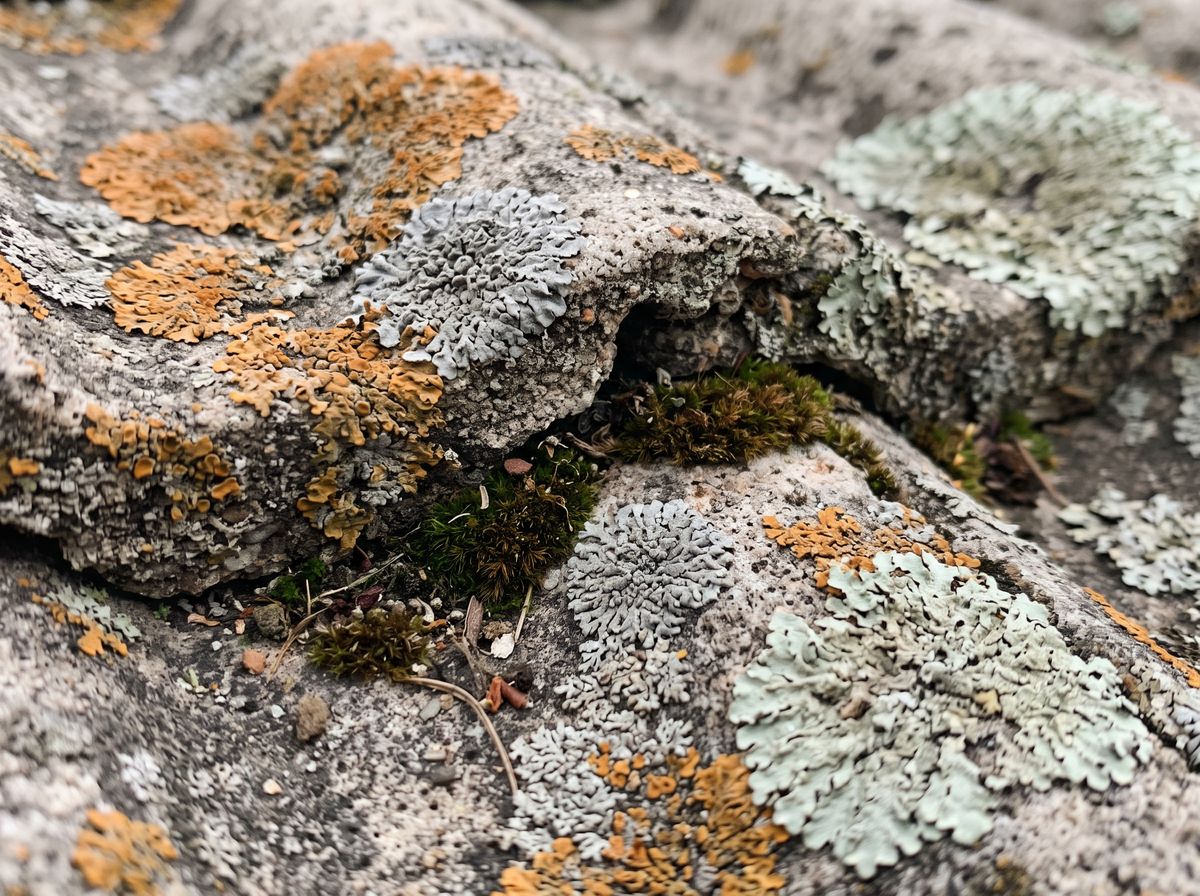
The grey, green, yellow and orange crusts on many older tile roofs are lichen, and the soft green cushions in shaded corners are usually moss. They are among the first things people notice about a tired roof, and they tend to be either treated as an emergency or ignored. The reality sits in between.
This guide explains what the growth is, why it appears where it does, what it can and cannot do to a roof, and the options for removing it and slowing its return.
What are lichen and moss?#
Lichen is not a single plant. It is a fungus living in partnership with an alga or a cyanobacterium: the fungus forms the body and grips the surface, while its partner makes food from sunlight. On roofs it forms flat, crusty or slightly leafy patches and grows very slowly, which is why heavy cover usually means a roof has been in place for many years.
Moss is a small, simple plant without true roots. It forms soft mats or cushions, needs more moisture than lichen, and on Perth roofs usually stays in damp, shaded spots such as the lower rows of tiles near the gutter or the side of the roof under a tree. In summer it can dry out and turn brown, then green up again with winter rain.
Why does lichen grow on some roofs and not others?#
It needs shade, moisture and a surface it can grip. The common factors are:
- Shade. Roof slopes facing south get the least direct sun in the southern hemisphere, and areas under trees or beside taller buildings stay damp longer after rain and dew.
- Moisture. Lower courses near gutters, areas below valleys and low-pitched sections drain and dry more slowly.
- Surface texture. Weathered concrete tiles that have lost their original surface coating, unglazed terracotta and asbestos cement are rough and porous. Glazed terracotta and pre-painted steel are smoother and shed water faster, so growth is usually lighter. Our guide to concrete and terracotta tiles explains how each weathers.
- Debris. Leaves, seeds and dust lodged in tile laps hold water and give moss a place to start.
Do lichen and moss damage roof tiles?#
Mostly they are a surface problem, but they are not entirely harmless. What they can do:
- Hold moisture against the tile surface for longer after rain, which keeps porous tiles damp.
- Partly block the laps between tiles and the paths water uses to drain, especially where moss traps leaves and grit.
- Wash into valleys and gutters as they break up, adding to blockages and overflow.
- Make the roof surface slippery, particularly when wet, which WA Health notes as a hazard for anyone working on a roof.
Heavy lichen on concrete tiles is also a sign that the surface has weathered and become more porous, so it is as much a symptom of wear as a cause of it. What lichen does not usually do is cause a leak on its own. If water is coming in, the likely source is a broken tile, ridge, valley or flashing, and a roof leak repair should start by finding it.
How is lichen removed from a roof?#
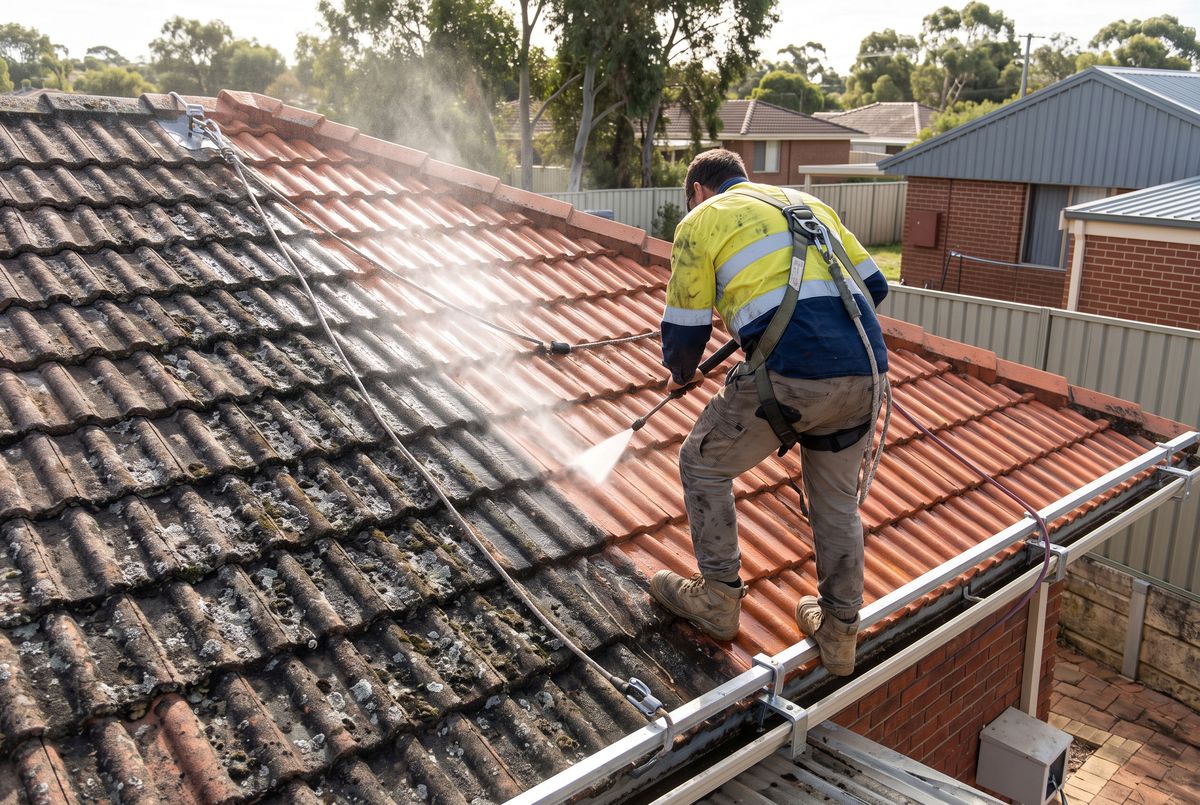
Removal is a job for a roof cleaner working with fall protection, and the roof cleaning page compares methods in detail. In outline, a contractor may propose:
- Pressure cleaning, which strips growth and loose surface material from sound tile roofs and is usual before repairs and a coating. It is never used on asbestos cement and needs care on weathered tiles.
- A treatment product applied at low pressure to kill the growth, which then breaks down and is rinsed or weathers away over time. It is gentler but slower to show results.
- A combination, treating first and cleaning afterwards, which is common before a roof restoration.
Whichever method is proposed, ask for the product name and its safety data sheet, whether it suits your roof material, coating and gutters, and how long must pass before any coating goes on.
What precautions should be taken with runoff?#
Everything that comes off the roof goes somewhere: into the gutters, through downpipes to soakwells or stormwater, and over the edge onto gardens, paving and cars. Before the work starts, agree how runoff and overspray will be managed and how lichen debris will be cleared from the gutters at the end, because left in place it blocks them.
If you collect rainwater, the tank inlet should be disconnected or diverted while the roof is cleaned or treated. Healthy WA’s general advice for tank owners, to let the first good rains each year run to waste and to keep roof catchments clear of leaves, is worth following afterwards too.
What about lichen on an asbestos cement roof?#
Homes built before about 1990 may have asbestos cement roofs, and their weathered surface is especially prone to lichen. WA Health’s guidance note on these roofs says weathered sheets become more easily wetted and prone to mosses and lichens, which may weaken the cement further while possibly also acting as a barrier to weathering. Because that effect is uncertain, WA Health does not use lichen as a measure of an asbestos roof’s condition.
Never pressure clean an asbestos cement roof. Cleaning asbestos cement with pressure water or air is prohibited in WA under the Health (Asbestos) Regulations 1992 and work health and safety laws. It erodes the sheet surface and spreads asbestos-contaminated slurry across the property and onto neighbouring land.
Where treatment of an asbestos roof is considered, WA Health’s guidance describes applying a biocide first and using only gentle wet methods, with no dry brushing. The department’s broader position is that ageing asbestos cement roofs should be removed and replaced where practical. Get specialist advice before anyone works on the roof: see the asbestos roofs guide and asbestos roof replacement.
How can you slow lichen and moss coming back?#
On most shaded or porous roofs the growth returns eventually, but a few things slow it down:
- Let in light. Have branches over the roof pruned back by an arborist.
- Keep water moving. Keep gutters and valleys clear so the lower rows of tiles dry out; see the roof maintenance checklist.
- Seal the surface. On concrete tiles, cleaning followed by a compatible coating leaves a smoother, less porous surface; see roof painting.
- Ask about follow-up treatments. Some products are sold as longer-acting. Ask what the label claims and how the contractor would reapply it.
- Take care with copper. Copper strips are sometimes sold to discourage moss, but water draining from copper accelerates corrosion of zinc and aluminium-zinc coated steel, so they should not sit above steel gutters, valleys or flashings.
Frequently asked questions
Can I spray a lichen treatment on my roof from the ground?
It is better left to a roof cleaner. Products sprayed from below drift onto gardens, paving and people, may not suit every roof material or coating, and need to reach the whole roof surface to work. A contractor should name the product and explain how runoff will be managed.
Does lichen grow on metal roofs?
It can, though usually less than on tiles, because painted steel is smooth and sheds water quickly. Growth tends to appear in shaded, sheltered spots or where leaves and dirt collect, such as low-pitched sections and around gutters. Any cleaning method should suit the coating on the steel.
Why does lichen grow more on one side of my roof?
Usually because that side stays damp for longer. Roof slopes facing south get the least direct sun, and areas shaded by trees or neighbouring buildings dry slowly after rain and dew, so lichen and moss establish there first.
Is the orange or white crust on my tiles lichen?
Orange, yellow, grey-green and pale crusty patches are usually lichen. A white, powdery bloom on concrete tiles can instead be efflorescence, a mineral deposit that comes from within the concrete. A contractor can tell the difference at an inspection, and it changes which treatment makes sense.
Do zinc or copper strips stop moss growing on a roof?
They are sold for that purpose, so ask the supplier what results to expect on a roof like yours. Copper is a poor choice wherever water from it would drain onto coated steel gutters, valleys or flashings, because copper runoff speeds up corrosion of zinc and aluminium-zinc coated steel.