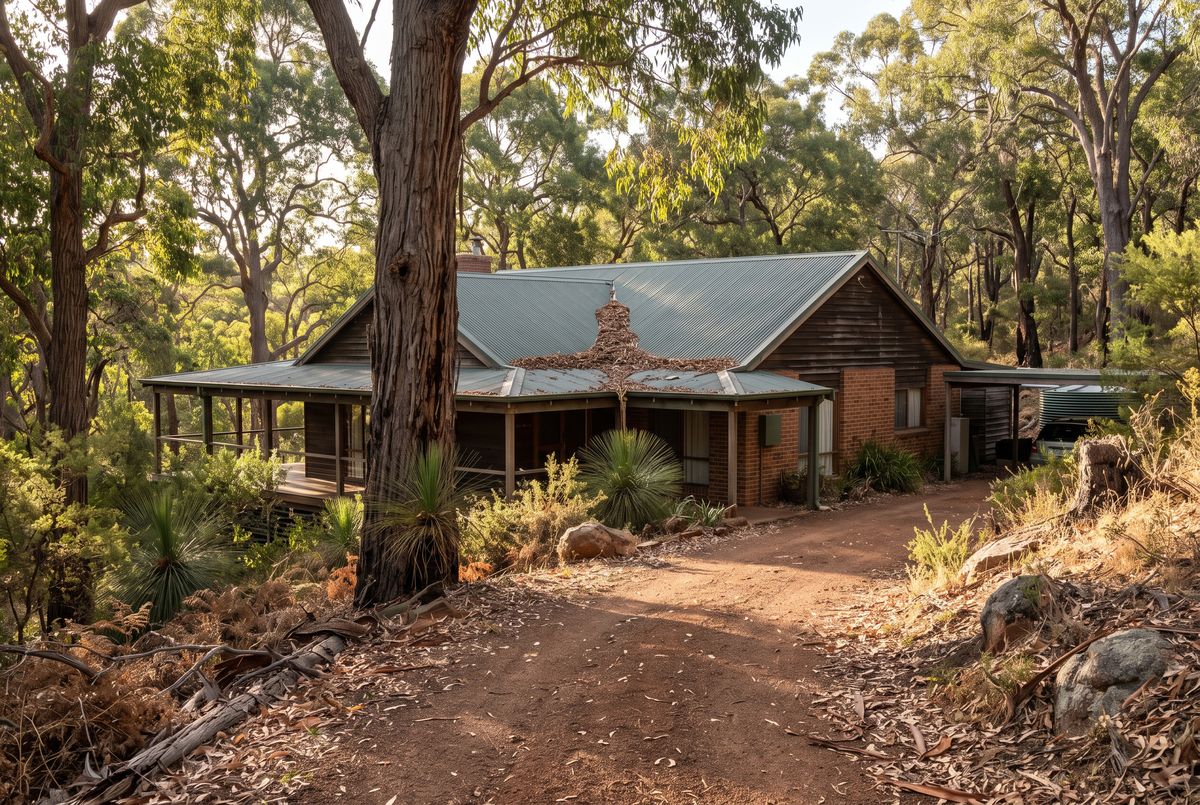
Large parts of the Perth Hills and many suburbs on the urban fringe sit in or beside bushland. In a bushfire, the roof and gutters of a house in those areas are a common place for embers to land and find fuel or a way in.
This guide covers the roof side of bushfire preparation. For a full household plan, use the resources on the DFES website.
Is my home in a bushfire prone area?#
You can check on WA’s Map of Bush Fire Prone Areas, which is designated by the Fire and Emergency Services Commissioner and can be viewed online through the WA Government. It covers bushfire prone vegetation plus a 100 m buffer around it, including much of the Perth Hills and many urban-fringe suburbs. Newly designated areas are shown with a blue cross-hatch during a four-month transition period for planning and building purposes, and existing areas are shown in pink.
Being mapped matters mainly for new building work, which may have to meet bushfire construction requirements. See roofing in the Perth Hills for the local housing picture.
What is a BAL rating?#
A Bushfire Attack Level (BAL) rates a site’s potential exposure to bushfire, assessed under Australian Standard AS 3959, Construction of buildings in bushfire-prone areas. It considers the type of vegetation, its distance from the building and the slope of the land. There are six levels: BAL-LOW, BAL-12.5, BAL-19, BAL-29, BAL-40 and BAL-FZ (flame zone). Construction requirements for new work, including roofs, step up with the BAL, and the WA Government points homeowners to accredited BAL assessors listed by the Fire Protection Association Australia.
The WA Government’s guidance on roof-mounted evaporative coolers shows how much the requirements change between levels:
| BAL | Risk described by the WA Government | What a new roof-mounted evaporative cooler needs |
|---|---|---|
| BAL-LOW | Low | No bushfire requirements |
| BAL-12.5 to BAL-29 | Moderate to high | Non-combustible butterfly closers near roof level, or non-combustible covers with mesh of no more than 2 mm aperture, plus sealing to the roof so no gap exceeds 3 mm |
| BAL-40 and BAL-FZ | Very high to extreme | A building permit, because these units are not permitted unless they meet test criteria or an alternative solution is developed |
How do embers threaten a roof?#
Embers are burning twigs, leaves and bark carried by the wind, and they start fires wherever they find dry fuel or a gap. On a roof, the main weak points are:
- Gutters and valleys full of dry leaves, which embers can ignite right at the roof edge.
- Gaps under the roof covering, at ridges and hips where pointing has failed, at the eaves, at the ends of corrugated sheets and around broken or slipped tiles.
- Unsealed roof-to-wall junctions, which the WA Government’s building guidance says should be sealed to prevent gaps.
- Vents, skylights and whirlybirds without ember mesh.
- Roof-mounted evaporative coolers. DFES has identified that embers entering through unprotected gaps can ignite the cooling pads, and fire can then burn into the ceiling.
- Hidden leaf litter behind solar panels, around air-conditioning units and in box gutters.
How should gutters be prepared for fire season?#
Keep them clear, and keep them that way. DFES’s property preparation checklist lists cleaning gutters among the jobs to repeat monthly during fire season. Some local governments’ annual fire hazard reduction notices, issued under the Bush Fires Act 1954, also require roofs and gutters to be kept free of flammable material, as the City of Kalamunda’s does. Check your own local government’s notice for the requirements and dates that apply to you.
Building and Energy advises that gutters be made of non-combustible material and that non-combustible leaf guards over gutters and valleys can help stop embers igniting leaf litter. Plastic guards can melt or burn, so ask whether a product is non-combustible before it goes on. Guards still need checking, because leaves pile up on top. If your gutters are damaged or due for replacement, see gutter repairs, and for the year-round routine, the roof maintenance checklist.
Which gaps in the roof should be sealed?#
Any gap an ember could lodge in or pass through. DFES’s checklist includes, as a yearly task, blocking gaps in roof spaces, under eaves, and around external vents, skylights and chimneys, and fitting metal fly wire mesh to windows and vents. On the roof itself, that usually means:
- Replacing broken, cracked or slipped tiles; see tile roof repairs.
- Repointing or rebedding ridge and hip caps where gaps have opened; see roof repointing.
- Closing the open ends of corrugated or profiled sheets at the ridge and eaves with suitable closures.
- Sealing where the roof meets walls, flues and other penetrations.
- Fitting ember mesh to roof vents and whirlybirds.
Building and Energy’s guidance is that roofs, roofing systems and accessories should be non-combustible. Ask the contractor which materials they will use, whether they suit your BAL and whether they are compatible with your roof metal.
What about roof-mounted evaporative coolers?#
From 8 April 2016, new roof-mounted evaporative coolers installed on homes in designated bushfire prone areas must be fitted with non-combustible covers, with the detail depending on the BAL. A plastic unit without a butterfly closer must be fully encased in non-combustible covers, not just covered at the air intakes. Upgrading an existing cooler is not mandatory, but the WA Government recommends discussing retrofit options with the retailer or manufacturer, and DFES’s checklist includes fitting a protective screen. If buying a new unit, ask the retailer to confirm in writing that it complies for your location.
A roof checklist before fire season#
- Have gutters, valleys and the roof cleared of leaves and twigs, and plan repeat clearing through fire season.
- Ask whoever clears the gutters to check behind solar panels, around air-conditioning units and in box gutters.
- Have broken tiles, failed ridge pointing and lifted flashings repaired.
- Check that roof vents, whirlybirds and the evaporative cooler have intact ember screens.
- Have branches that overhang the roof pruned back.
- Move wood piles, mulch and other flammable material away from the walls under the eaves.
- Read your local government’s annual fire hazard reduction or firebreak notice.
- Make or update your household bushfire plan using DFES resources.
Never climb onto the roof to clear leaves, and never go onto the roof during a fire. Book gutter and roof clearing with someone equipped to work at height, follow official warnings on Emergency WA, and call Triple Zero (000) in an emergency.
What changes when you reroof in a bushfire prone area?#
It depends on the work. Building and Energy notes that building standards are generally not retrospective, so a home does not usually have to be upgraded simply because it is mapped. New building work, additions and extensive renovations can trigger bushfire requirements, while some work on existing buildings is excluded. Ask your local government or a registered building surveyor whether your roof replacement is affected, and whether a BAL assessment is needed, before you finalise materials. Our guides to building permits for roof work and roof replacement cover the approvals.
Even where nothing is required, a reroof is a chance to improve ember resistance with non-combustible gutters and guards, sealed ridges and eaves, closures at sheet ends and mesh over vents. Ask each contractor how they would detail those parts.
Frequently asked questions
Do I have to upgrade my roof because my home is now in a bushfire prone area?
Generally no. Building and Energy notes that building standards are generally not retrospective, so being mapped does not by itself require changes to an existing home. New building work, additions and extensive renovations may have to meet bushfire requirements, so check with your local government before major roof work.
Are plastic gutter guards suitable in a bushfire prone area?
They are a poor fit. WA Government building guidance points to non-combustible gutter and valley leaf guards to help stop embers igniting leaf litter, and plastic can melt or burn. Ask the supplier whether a product is non-combustible and suits your BAL.
Does my existing evaporative cooler need ember protection?
Upgrading an existing roof-mounted cooler in a bushfire prone area is not mandatory, but the WA Government recommends discussing non-combustible covers with the retailer or manufacturer. New units installed in designated areas since 8 April 2016 must have non-combustible covers suited to the site’s BAL.
How often should gutters be cleared during fire season?
DFES’s property preparation checklist lists cleaning gutters among the jobs to do monthly during fire season. Homes under or close to trees may need it more often. Book someone equipped to work at height rather than climbing up yourself.
What if I live near bushland but outside the mapped area?
Ember preparation is still worthwhile. The map decides where bushfire building requirements apply, not where embers can travel, so clear gutters, sealed roof gaps and screened vents make sense anywhere close to bushland.