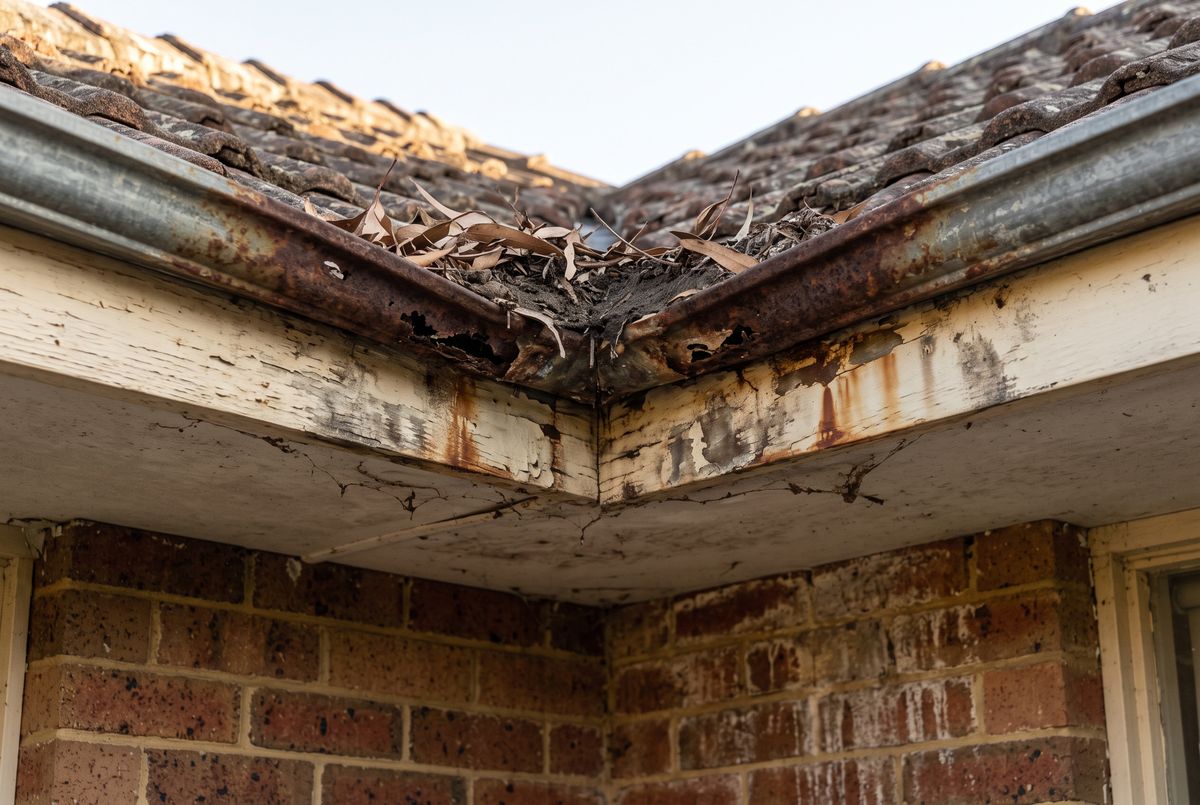
Rust is the main way steel roofs, gutters and the metal parts of tile roofs wear out. It is also easy to misjudge in both directions: a few rust spots do not necessarily mean a new roof, and a fresh coat of paint over rusted-through steel does not fix anything. What matters is how far the rust has gone and what is causing it.
Steel roofing is protected by a zinc or aluminium-zinc coating, and often paint on top. Red-brown rust appears once that protection has been breached or used up. On unpainted metallic-coated steel, early corrosion often shows first as white or grey deposits.
Is it surface rust or rust-through?#
You can judge the stage roughly from the ground, but only a close inspection can confirm how much sound metal remains.
| Stage | What you might see from the ground | What it usually means |
|---|---|---|
| Rust staining | Small rust-coloured spots on a fairly new roof, often near screws or cut ends | Often swarf, the steel filings left from cutting or drilling, rusting on the surface; the sheet may be fine |
| Surface rust | Orange-brown patches, or blistering and flaking paint at edges, laps or fixings | The coating has been breached but the steel is still solid and may be treatable |
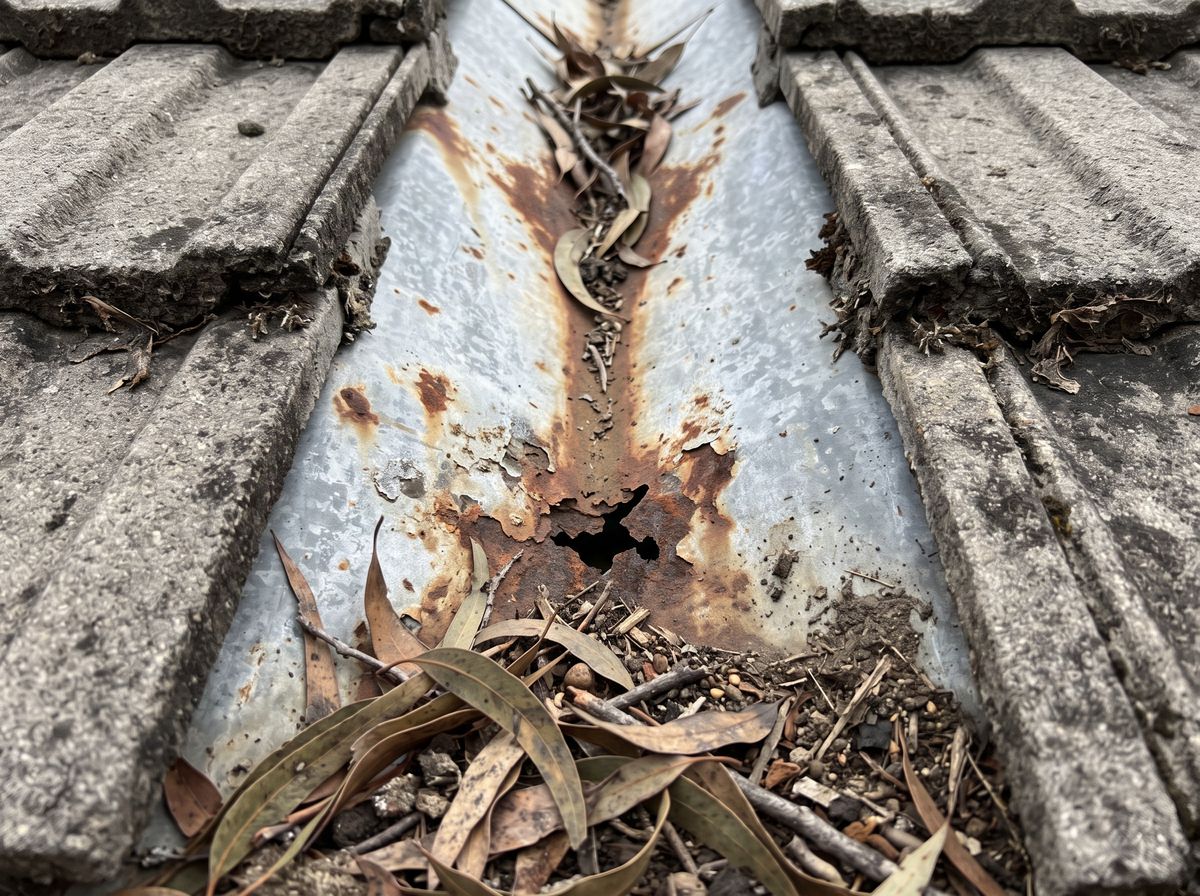
| Advanced corrosion | Flaking layers, pitting, heavy rust at laps or along the gutter floor | The steel is thinning; repair needs a close look before anyone commits to a coating |
| Rust-through | Holes, crumbling edges, drips in rain or daylight showing in the roof space | Metal has been lost and that section needs replacing |
Where does rust usually start?#
Where water and dirt sit, and where the protective coating has been cut or worn:
- Laps. Where sheets overlap, moisture is drawn in between them and dries slowly.
- Fixings. Screw heads, perished washers and the holes around them, or the nails on older roofs.
- Cut edges and scratches. Sheet ends at the gutter and ridge, flashing edges and damage from foot traffic or dragged tools.
- Under debris. Leaves and silt in gutters, valleys and box gutters, and behind solar panels or air-conditioning units.
- Valleys. Valley irons carry concentrated flow and collect debris; see roof valley repairs.
- Gutters. The gutter floor, joints, corners and outlets, usually from the inside first.
- Drip points. Places where something drips onto the roof repeatedly, such as an air-conditioner drain line, a hot water overflow or a tree branch.
What makes rust speed up?#
A few conditions turn slow wear into fast corrosion:
- Salt air. Near the ocean, salt settles on metal and holds moisture, especially in sheltered spots. See coastal roofs and salt corrosion.
- Incompatible metals. Copper, lead and some stainless steels attack coated steel when they touch it, and copper also does harm through the water that runs off it. Copper hot water overflow pipes and old lead flashings are the usual culprits.
- Standing water. Sagging gutters, low-pitched sections and blocked outlets keep metal wet for days.
- Damaged coatings. Walking on sheets, abrasive cleaning and careless installation scratch through the protection.
- The wrong sealant. Some sealants give off by-products as they cure that damage steel coatings, so a quick silicone patch can make matters worse.
What repair options might a contractor propose?#
The right option depends on the stage, the extent and the cause. If the cause is not dealt with, such as a copper pipe draining onto the roof, rust will return around the repair.
| Option | When it can make sense | Questions to ask |
|---|---|---|
| Cleaning off swarf and staining | Fresh spots on a newer roof | Did the spots come from installation, and who is responsible? |
| Replacing fixings | Rust around screws or perished washers | Are the new fixings compatible and suited to the site? |
| Rust treatment and coating of affected areas | Surface rust on otherwise sound steel | How will loose rust be removed, which primer and topcoat will be used, and do they suit the existing coating? |
| Replacing sheets, flashings or valley irons | Rust-through in one area | Will the profile match, and how will new and old materials be joined? |
| Replacing gutters and downpipes | Rust-through in several places along a run | Which material and profile, and is the fascia behind it sound? See gutter repairs |
| Replacing the roof | Widespread rust-through, many corroded laps or coating gone on most sheets | What product suits the site, and does the job need a building permit? See roof replacement |
Paint over a hole is not a repair: perforated sections have to be replaced before any coating goes on. And because BlueScope advises against touch-up paint on COLORBOND steel, ask how minor scratches will be handled. For whole-roof coatings, see roof painting, and for repairs to steel roofs generally, see metal roof repairs.
What about older galvanised roofs?#
Many older Perth homes, particularly in the inner suburbs, have galvanised steel roofs, often called corrugated iron or tin. The zinc coating protects the steel by slowly corroding in its place, so over decades it thins and eventually leaves bare steel to rust. Typical signs are a dull, patchy grey surface with rust starting at laps, around nail or screw holes and along the lower edge near the gutter.
A galvanised roof that is still mostly sound can sometimes be repaired, or prepared and painted with a system made for galvanised steel. Once rust is widespread, replacement is usually the conversation. Joining new sheets or gutters to old galvanised steel raises compatibility questions, including which way the water runs between them. Replacing the roof with the same material and profile is treated differently from changing to a new material for building permit purposes, so read about building permits for roof work before you compare quotes.
Why do gutters and valley irons often rust first?#
Because they hold water and debris for longer than the roof sheets do. A steel gutter rusts from the inside floor, so it can look fine from the ground while thinning. Drips along the run during rain, rust streaks on the fascia and sagging between brackets are the usual warnings.
Valley irons on tile roofs rust under trapped leaves and tend to leak into the roof space near internal corners. Both gutters and valley irons can usually be replaced without replacing the whole roof, although a valley replacement means lifting the cut tiles along each side.
Is a rusty roof safe to work on?#
Not without proper precautions, and never for a homeowner.
Rusted sheets, gutters and valley irons can be thin enough to give way under a person’s weight, and corroded edges are sharp. Do not walk on a rusty roof or lean a ladder against a rusted gutter. Contractors must manage fall risks under WA work health and safety laws. If your home was built before about 1990 and any roof or eave sheeting looks like cement rather than metal, treat it as possible asbestos until tested.
Frequently asked questions
Why are there small rust spots on my new roof?
They are often swarf: tiny steel particles from cutting or drilling that were not cleaned off and have rusted on the surface. BlueScope says preventing swarf staining is the responsibility of the installer and following trades, so raise it with whoever did the work.
Does rust on the underside of gutters matter?
It is worth watching. The underside of eave gutters is sheltered from rain, so salt and dirt build up there, especially near the coast. Hosing it from the ground helps, and rust that spreads or starts to drip in rain suggests the gutter is thinning.
Can rust spread from one roof sheet to another?
Rust does not jump between sheets like an infection, but the conditions that caused it usually affect neighbouring sheets too. Runoff from incompatible metals or rusting debris can also stain or attack the sheets below, so the cause should be fixed along with the damaged section.
Will a rust converter fix a rusty roof?
Not on its own. Rust treatments can be part of preparing surface rust on sound steel for a coating system, but they cannot replace metal that has rusted through. Ask which products are proposed and whether the coating manufacturer approves them for your roof.
Should rusty galvanised gutters be replaced with the same material?
Not necessarily. Replacement gutters can be pre-painted or metallic-coated steel, among other options, but every new part should be compatible with the roof that drains into it and with anything staying in place. Ask the contractor to confirm compatibility in writing.