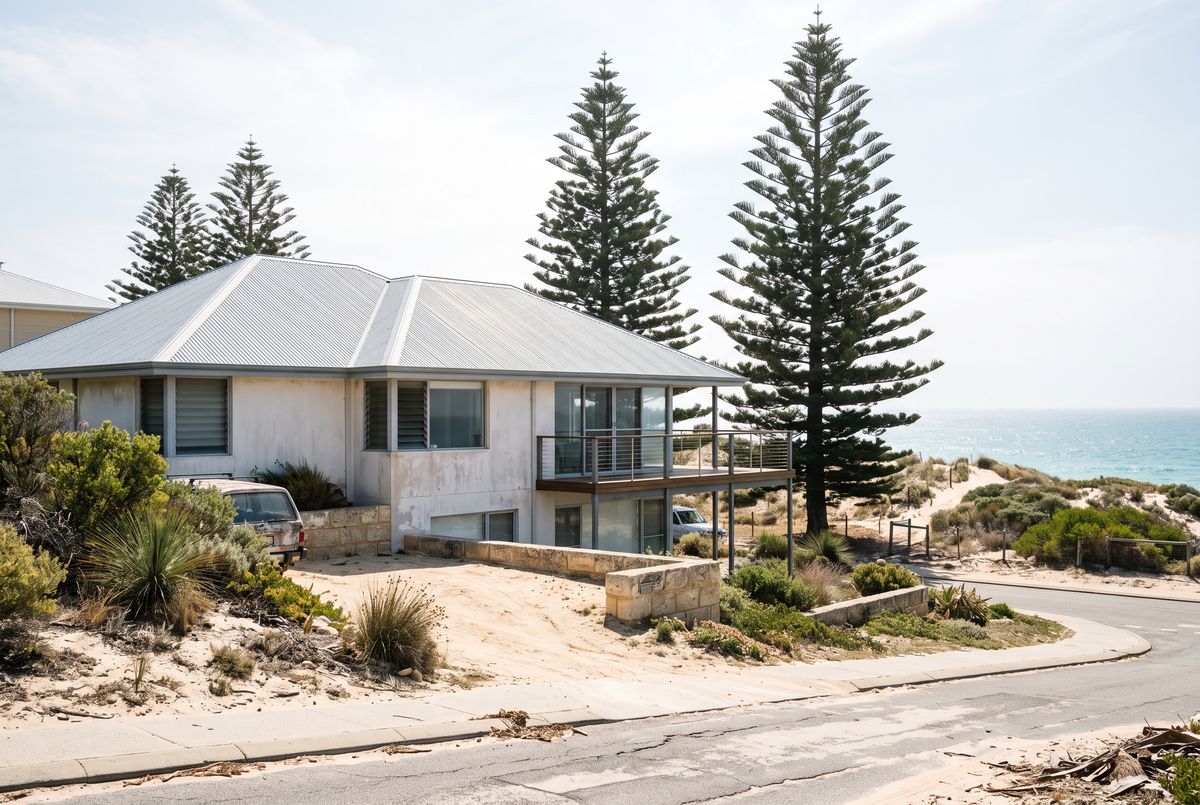
From the northern beaches to Fremantle and Rockingham, many Perth homes sit close enough to the ocean for salt to matter. Salt does not damage tiles, but it shortens the life of every piece of metal on a roof: steel sheets, screws, flashings, gutters and the valley irons on tile roofs.
Coastal corrosion is fairly predictable: it starts in the same places on most roofs, gives visible warning and can be slowed with simple care from the ground.
How does salt corrode a roof?#
Salt spray from breaking waves is carried inland by onshore wind and settles on surfaces as a fine film. Salt draws moisture from the air, so on humid nights and dewy mornings that film stays damp, and a damp, salty surface is ideal for corrosion.
Roofing steel is protected by a metallic coating of zinc or an aluminium-zinc alloy, and pre-painted steel such as COLORBOND steel adds paint layers over that. Corrosion is slow while those layers are intact and speeds up where they are thin, scratched or cut, or where salt sits undisturbed. Rain rinses exposed surfaces, which is why the worst corrosion is often where rain cannot reach.
How close to the ocean counts as coastal?#
There is no single line. BlueScope grades its roofing products by distance from breaking surf, measured from the high-water mark. It recommends premium marine-grade products, such as COLORBOND Ultra steel or stainless steel, for the sites closest to the surf, standard COLORBOND steel further back, and unpainted ZINCALUME steel further inland again. Its tables also treat calm marine water, such as sheltered bays, differently from surf beaches, and note that prevailing winds and unwashed areas affect real-world performance.
Published distances differ between documents and product ranges, so treat any figure as a starting point. Ask the supplier or contractor to name the product they recommend for your address and to confirm in writing which warranty applies there. Mention your location when you ask for quotes for metal roof repairs or a roof replacement. For the beachside suburbs in particular, see roofing in the western suburbs and coast.
Which parts of a coastal roof corrode first?#
Usually the small parts and the hidden ones, rather than the middle of a sheet:
- Fixings. Screw heads, washers and rivets, especially where the fixing is not rated for a coastal site.
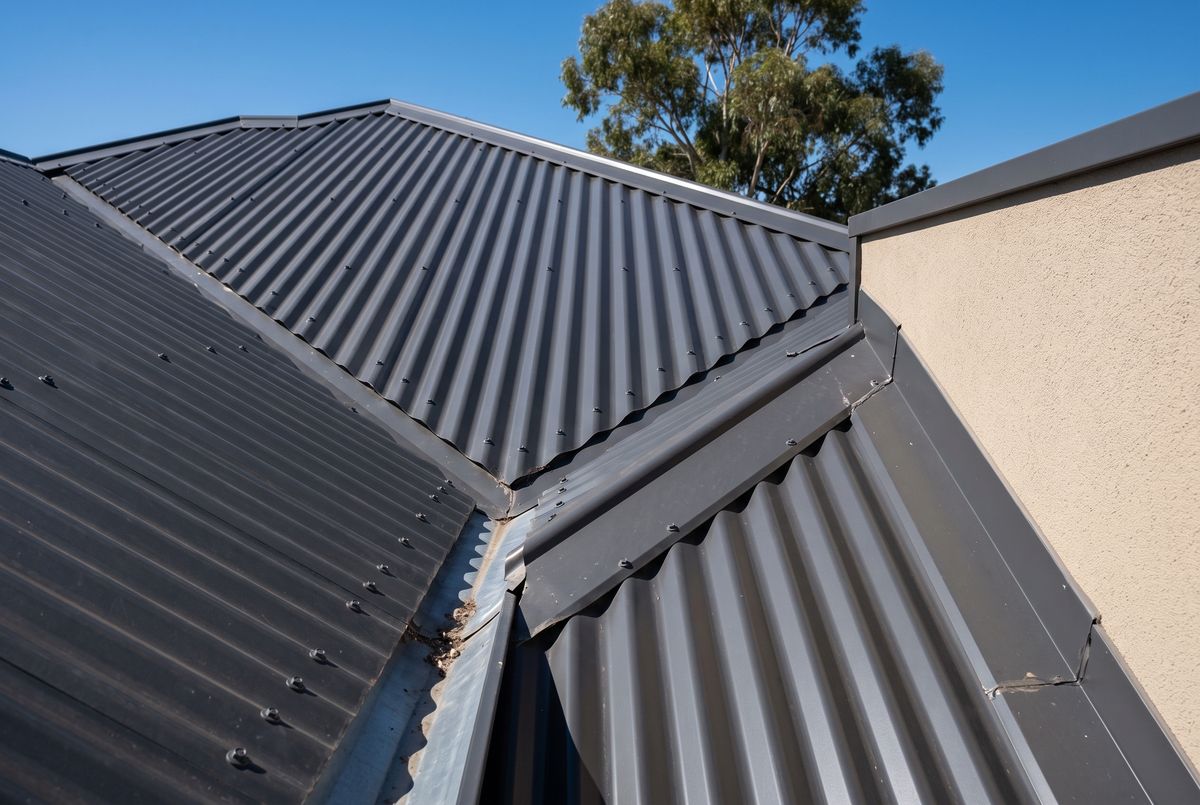
- Laps. The overlaps between sheets, where salty moisture is drawn in and stays.
- Cut edges. Sheet ends, flashing edges and anywhere the coating was cut during installation.
- Flashings and cappings. Folds, joints and the edges of ridge and barge cappings.
- Gutters. The inside base where silt and leaves stay wet, the joints and outlets, and the underside of the gutter.
- Metal parts of tile roofs. Valley irons, flashings and gutters, even though the tiles themselves do not rust.
- Sheltered roof areas. Sections under an upper-storey overhang, behind a parapet or beneath solar panels.
- Roof-mounted items. Antenna brackets, solar mounting rails, vent cowls and evaporative cooler frames.
Why do sheltered areas need rinsing?#
Because nothing else removes the salt. BlueScope’s maintenance advice is that surfaces washed by rain generally look after themselves, but areas the rain misses, such as wall cladding under the eaves, the top of garage doors and the underside of eave gutters, should be hosed down at least every six months, and more often in coastal areas where marine salt spray is prevalent. It suggests fresh water and a sponge, soft cloth or soft nylon brush, with no abrasive scourers or steel wool, and a thorough rinse if any detergent is used.
What a homeowner can reasonably do from the ground:
- Hose the underside of eave gutters, the fascia and sheltered walls under the eaves.
- Rinse the underside of carport and patio roofs that rain does not reach.
- Keep garden mulch and soil from building up against steel downpipes and cladding.
- Use an ordinary garden hose rather than a pressure cleaner.
- Note any rust, blistering or white powder you see while you rinse, and photograph it.
Rinse only what you can reach with your feet on the ground. Do not climb onto the roof or work from a ladder at the roof edge. The main roof surfaces are washed by rain, and anything higher than you can safely reach is a job for a contractor with fall protection.
How do dissimilar metals make corrosion worse?#
When certain metals touch, or when water runs from one onto another, one of them corrodes faster, and salty moisture helps that reaction along. BlueScope’s compatibility guidance lists copper, brass, lead and 300-series stainless steel as unsuitable for direct contact with COLORBOND and ZINCALUME steel. It also flags carbon black, which is found in some rubber washers, roof penetration flashings and the black pencils sometimes used to mark out sheets. Drainage counts too: water running off copper should not discharge onto coated steel.
On real roofs, that usually means old lead flashings left after a reroof, copper hot water overflow pipes dripping onto sheets or gutters, and stainless screws fitted as an “upgrade”. Sealants matter too: BlueScope warns that some common sealants release by-products while curing that can attack the coating on its steel, so ask which sealant a repair will use. The roof flashing repairs page covers flashing materials in more detail.
What are the signs of corrosion on a coastal roof?#
Most early signs are visible from the garden, the street or an upstairs window, and a phone camera’s zoom helps:
- White or grey powdery deposits on unpainted metallic-coated steel.
- Paint that blisters, bubbles or flakes, often starting along edges, laps and around screws.
- Red-brown rust spots or streaks running down from fixings, laps or cut ends.
- Rust along gutter joints, drips from the gutter base in rain, or rust stains on the fascia.
- Screw heads that look swollen or rusty, or gaps where fixings are missing.
- Ceiling stains near the eaves or under sheet laps after rain.
The guide to rusty roofs and gutters explains how to tell surface rust from rust that has gone through the metal.
Should corroded sheets be repaired or replaced?#
It depends on how far the corrosion has gone and how much of the roof is affected. An inspection should establish whether the steel is still sound, whether the problem is local or widespread, and whether the cause can be removed.
| What is found | Options a contractor may discuss | Worth asking |
|---|---|---|
| Rust around a few screws | Replacing fixings and treating the area around them | Are the new fixings rated for my distance from the surf? |
| Corrosion along one flashing, capping or valley | Replacing that component | Is the new material compatible with the existing roof? |
| Gutters rusting at joints or along the base | Replacing gutter sections or runs (see gutter repairs) | Which gutter product suits this exposure? |
| Surface corrosion across sheets, steel still sound | Treatment and a compatible coating system | What preparation is included, and what warranty applies? |
| Holes, or corrosion at many laps | Replacing affected sheets or the whole roof | Which product grade and warranty suit this site? |
Two cautions apply. A coating cannot restore steel that has rusted through, so perforated sheets need replacing. And BlueScope does not recommend touch-up paint on COLORBOND steel, so ask how scratches and small damage will be dealt with during the job.
Frequently asked questions
Do tile roofs suffer from salt corrosion?
The tiles themselves do not rust, but a tile roof relies on metal parts that do: valley irons, flashings, gutters, downpipes and the brackets for solar panels or antennas. On a coastal tile roof, those components are usually the first to need attention.
How often should sheltered steel be washed near the beach?
BlueScope’s guidance is to hose down areas the rain does not reach at least every six months, and more often in coastal areas with heavy salt spray. Use fresh water and a soft brush or sponge, and only wash what you can reach safely from the ground.
Are stainless steel screws always the better choice near the coast?
Not automatically. BlueScope’s compatibility guidance lists 300-series stainless steel as unsuitable for direct contact with COLORBOND and ZINCALUME steel, so a fixing that resists rust itself can still harm the sheet around it. Ask which fixing class the roofing manufacturer specifies for your site.
Does living near the beach affect a roof warranty?
It can. Manufacturers grade roofing products by distance from breaking surf, and the warranty available can depend on the site and on maintenance such as washing sheltered areas. Ask for the warranty that applies to your address, in writing, before you accept a quote.
Do homes near the river or a sheltered bay need coastal-grade roofing?
Possibly. BlueScope’s product tables treat calm marine water differently from breaking surf, and local wind and sheltered areas also play a part. Rather than assuming either way, ask the supplier or contractor to assess your address and name the recommended product.