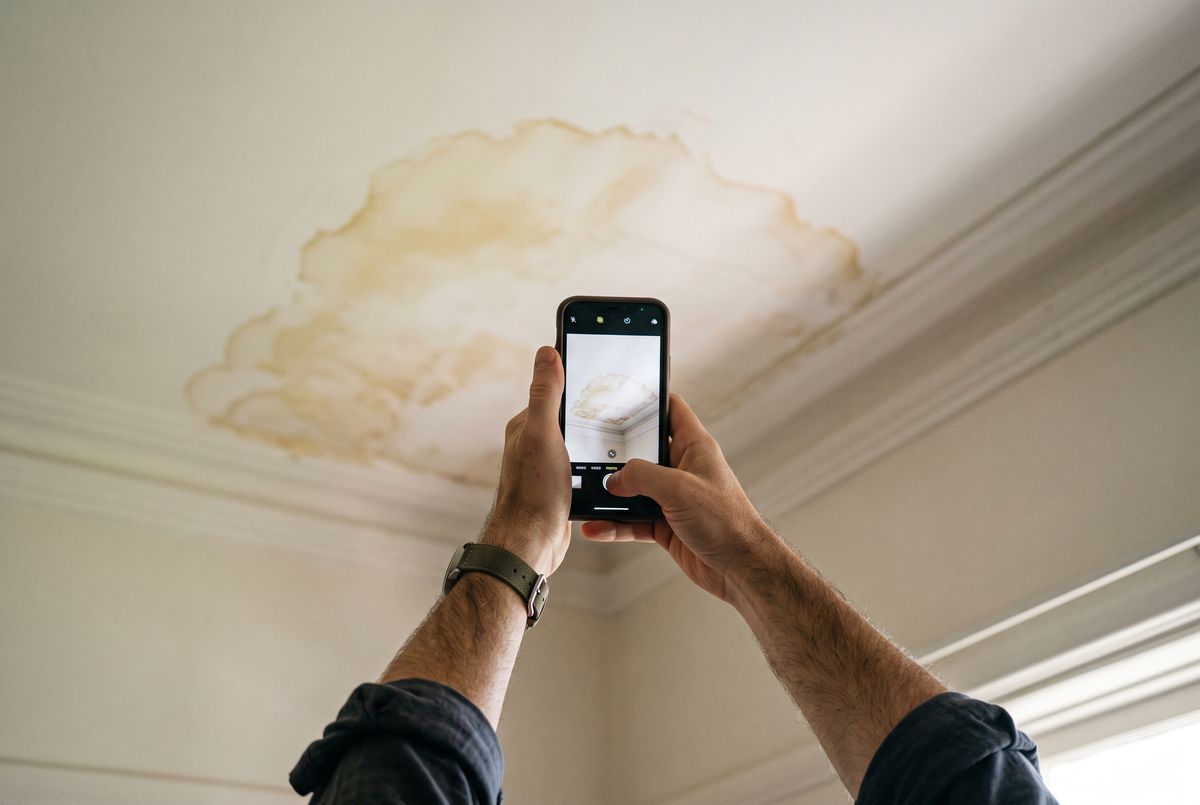
Finding a leak is detective work. The stain on the ceiling tells you where water ended up, not where it got in, and the two can be metres apart. The most useful thing a homeowner can do is collect clues, so that a contractor can test the likely entry points rather than guess.
This guide explains how water moves through a roof, where leaks usually start and what you can observe without going onto the roof. If water is coming in right now, read what to do when your roof leaks first.
Why is the stain rarely right under the leak?#
Water follows gravity and surfaces, so it travels before it drips. Once it gets past a tile or sheet, it can run down the sarking, along a batten or rafter, or across the top of the ceiling and insulation until it reaches a low point, a joint in the plasterboard or a light fitting.
On a tile roof without sarking, water drops straight onto whatever is below the gap and then spreads. On a steel roof, water can be drawn back along a sheet overlap or run along the underside of the sheet before it falls. Either way, the stain marks the end of the path. A contractor works back from it, uphill and towards the nearest junction or penetration.
Where do roof leaks usually start?#
Most leaks start at a junction, a penetration or a damaged piece of the covering, rather than in the middle of an intact roof plane. The diagram shows the main parts of a roof.
The usual suspects are:
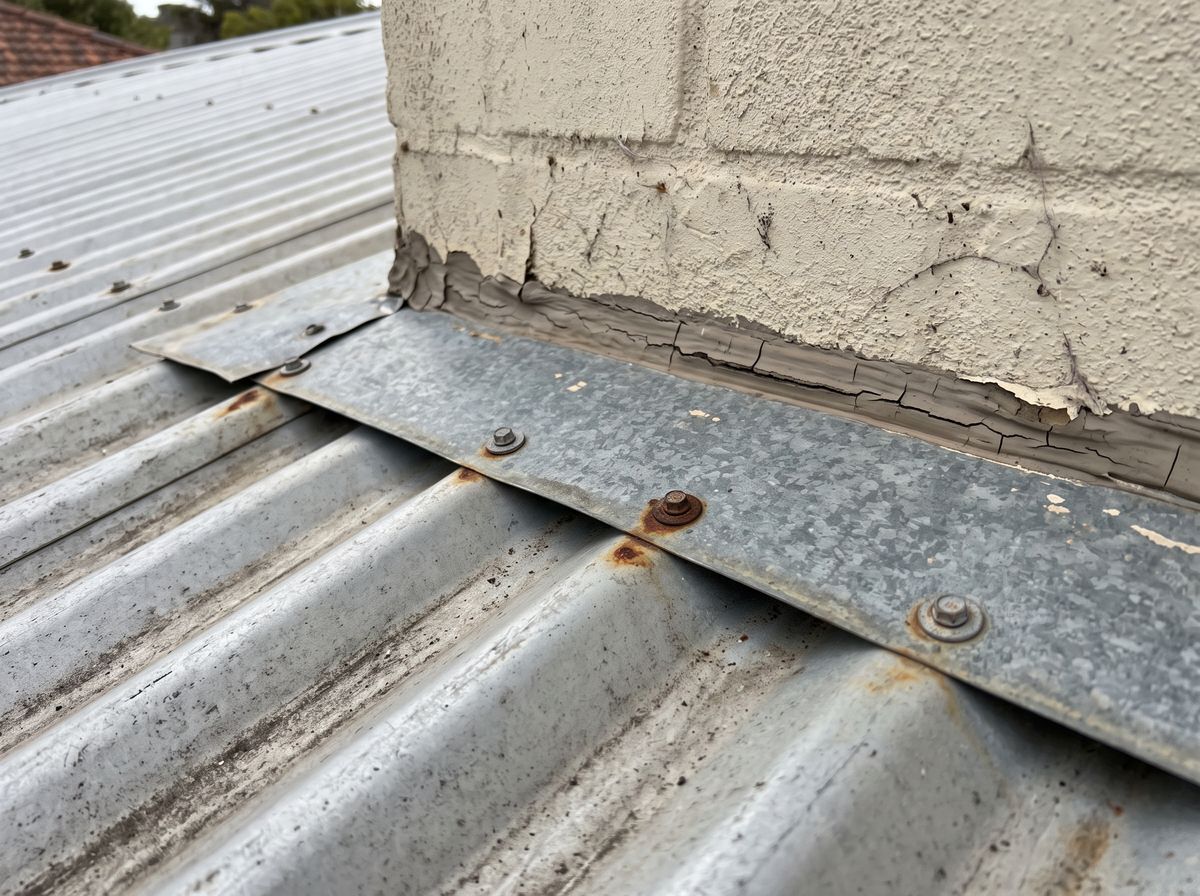
- Flashings where the roof meets a wall, chimney, skylight, vent pipe or parapet. Sealant cracks in the sun and flashings lift or rust. See roof flashing repairs.
- Valleys, where two roof slopes meet and channel a lot of water. Valley irons rust, and leaves or cut tiles can dam the flow so water spills sideways. See roof valley repairs.
- Ridges and hips, where gaps open in the pointing or the caps work loose from their mortar bed. See roof repointing.
- Cracked, slipped or missing tiles, often after storms or foot traffic from other trades.
- Steel roof fixings and laps, where screws loosen or their washers perish, or sheet overlaps let wind-driven rain in.
- Roof penetrations for solar conduit, antennas, flues and evaporative cooler ducts, especially if the seal was improvised.
- Gutters, including box gutters and gutters that overflow back into the eaves when blocked. See gutter repairs.
What can you observe safely as a homeowner?#
You can gather most of the useful evidence from inside the house and from the ground. None of it requires going onto the roof.
Timing and weather
The pattern of a leak is often the strongest clue. Keep notes on:
- Whether it leaks in all rain or only in heavy downpours.
- Whether it only leaks when the wind blows from one direction. Wind-driven rain points towards flashings, laps and ridge capping on the exposed side.
- How quickly water appears after rain starts. A drip within minutes suggests a direct path; a delay of hours suggests water travelling a long way or soaking into insulation first.
- Whether it first showed up with the first heavy rain after summer, which in Perth usually arrives with winter cold fronts.
- Whether it keeps going long after the rain stops, which can point to water held in a blocked valley or gutter, or to a cause other than the roof.
Inside the house
Mark the edge of the stain lightly in pencil and photograph it after each rain, so you can see if it grows. Note where it sits in relation to outside features: below a valley, near a wall that has a roof above it, beside a chimney or under a skylight. Measuring from a corner of the room helps a contractor match the spot to the roof.
From the ground
Look at the section of roof above the stain from the garden, the street or an upstairs window. Check for slipped tiles, leaves in the valley, rusted flashings and whether the gutter on that side overflows in rain. Also think about recent work: a leak that started after a solar installation or an antenna replacement is a strong lead.
In the roof space
Only enter if there is a safe hatch and solid joists to kneel or stand on. Before going up, turn off the main switch, take a torch and let someone know, as Building and Energy WA recommends, and leave all wiring alone. Solar cabling remains live regardless of the main switch. Look for wet timber, drip marks on sarking and stained insulation, and photograph what you find. If it is cramped or hard to reach, leave it to a contractor.
Never go onto the roof to look for a leak, and do not run a hose over the roof yourself. Wet roofs are slippery and tiles break underfoot. Water testing is a two-person job for a contractor with fall protection.
Is it a roof leak, condensation or something else?#
Not every wet ceiling is a roof leak. Condensation, plumbing and appliances can all produce stains. These clues help tell them apart:
| Clue | Points to a roof leak | Points to condensation | Points to plumbing or an appliance |
|---|---|---|---|
| When it appears | During or soon after rain | Cold mornings, often without rain | Any time, including dry weeks |
| Where | One spot, often below a junction | Spread across the underside of a steel roof or sarking | Near bathrooms, kitchens, hot water units or ducts |
| Link to use | None | Worse after showers, cooking or drying clothes | Only when a tap, cooler or air conditioner runs |
| Other signs | Visible damage on the roof above | Droplets on cold metal surfaces | A water bill higher than usual |
Lysaght explains that condensation forms when air inside the building is warmer than the roof sheeting, and that household moisture from showering and cooking adds to it; a vapour barrier and roof space ventilation help control it. A roof-mounted evaporative cooler can also leak from the unit or around its roof penetration, and that kind of leak usually shows only when the cooler is running.
How do professionals trace a leak?#
A contractor combines a close inspection with tests that narrow down the entry point. Methods vary, but these are the common ones:
- Visual inspection on the roof, with the right fall protection, checking tiles, ridges, valleys, flashings, fixings and sealants above and uphill of the stain.
- Roof space inspection, following water marks on timber and sarking back towards the entry point.
- Water testing, where one section of roof is wet at a time, usually starting low and working upward, while someone watches inside. It is slow, but it can confirm the source.
- Moisture meters, which measure dampness in plasterboard, timber and insulation to map how far water has spread.
- Thermal imaging cameras, which show surface temperature differences. Damp areas often appear cooler, but the images need interpretation and the right conditions, and they do not see through the roof.
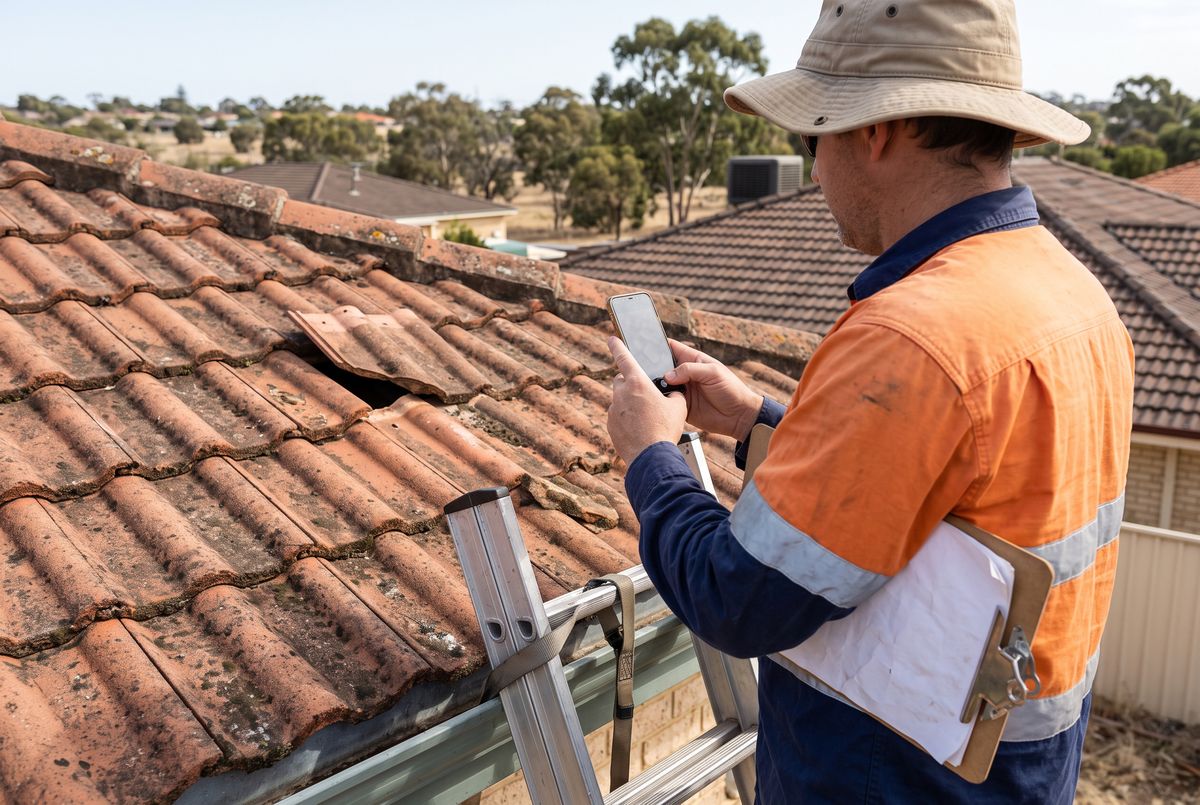
Ask which methods will be used, whether diagnosis is charged separately from the repair and what happens if the first repair does not stop the leak. A roof inspection report can also record the condition of the whole roof while someone is up there.
What should you record before the contractor arrives?#
A short log saves time on site. Note the dates and times of each leak, the rain and wind on those days, photos of the stain as it changes, any recent roof work and anything you saw from the ground or in the roof space. Add it to your roof leak repair enquiry so the contractor arrives with a plan.
Frequently asked questions
Why does my roof only leak when it is windy?
Wind can drive rain sideways or uphill under flashings, sheet laps, ridge capping and tile overlaps that stay dry in still rain. Note the wind direction when it leaks, because it points to the exposed side of the roof.
Why does the water appear hours after the rain starts?
Water may be travelling a long way along sarking, battens or rafters, or soaking into insulation before it reaches the ceiling. A long delay often means the entry point is some distance from the stain.
Can thermal imaging find every roof leak?
No. A thermal camera shows temperature differences that may indicate damp, but results depend on conditions and interpretation. Contractors usually combine it with a visual inspection, moisture readings or water testing.
Should I hose my roof to find the leak?
Not by yourself. Effective water testing needs one person wetting small sections in sequence and another watching inside, and anyone on or near the roof needs proper fall protection. Leave it to a contractor.
Could my evaporative air conditioner be causing the leak?
It can. Roof-mounted evaporative coolers can leak from the unit or around where they pass through the roof. If the stain only appears when the cooler runs, mention that to both a roofer and the cooler’s service technician.